无框架穹顶:创新自支撑隔热圆顶设计解析
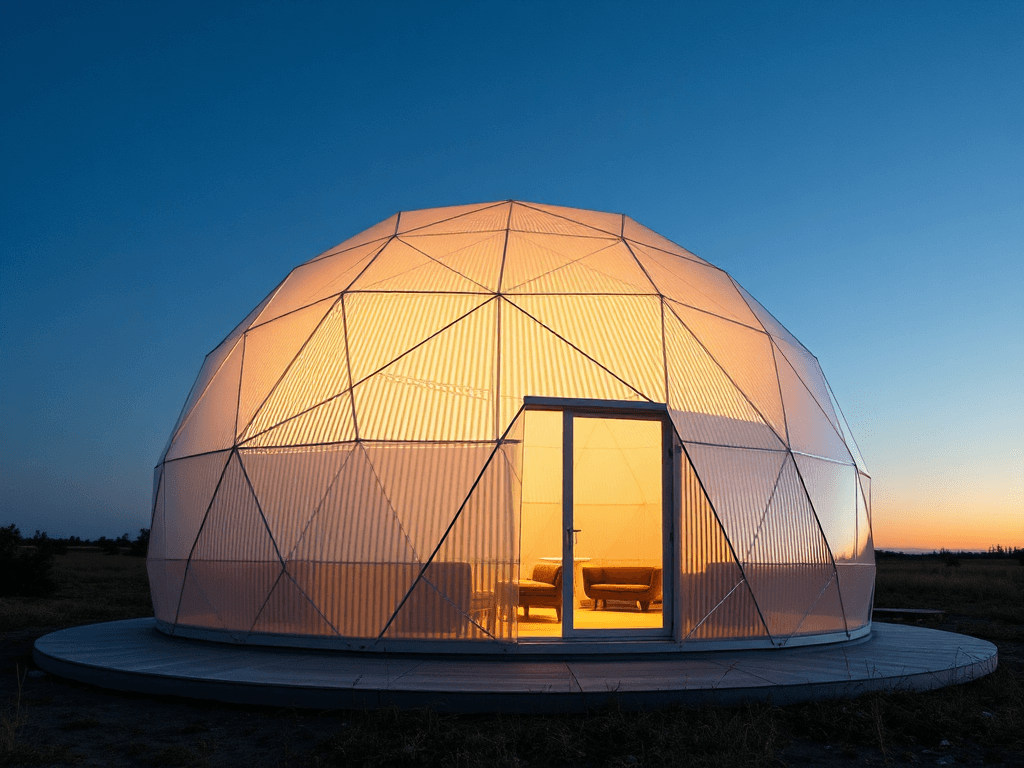
What is it?
It’s a frameless geodesic dome designed to be easy to fabricate and build.
It is 18 feet wide at the widest point and about 13 feet tall. It
feels very spacious for it’s 209 square foot floor.
The dome shell is built out of 3/16” corrugated plastic and 3/4”
blueboard foam insulation. The shell of the dome is a basically a foam
board insulation sandwich. There is an outer plastic dome, two layers
of tightly fitted blueboard insulation and then an inner plastic dome.
It’s all held together with bolts that bolt through all the layers.
The shell of the dome is about 2 1/2 inches thick.
There is no frame in this dome. The shell is self supporting much like
and igloo is self supporting.
The dome has a radial 2x4 floor system held up by cinder blocks. The
floor is also insulated with 2 layers of blueboard foam insulation.
It has electricity and is heated with a single electric radiator and
is cooled with an exhaust fan and small window sized air conditioner.
The materials are all easily attainable and it cost about $2100 to
build it at the time.
The dome shell is also extremely easy to disassemble making it
a portable structure.
Hacking housing
If I want to spend my time writing blog posts, exploring new
programming languages, and other things that I want to do but I am
unlikely to get paid for, it’s helpful to opt out of certain common
expenses. Housing is a major expense that is ripe for pruning.
Conventional housing requires that we spend a tremendous amount of
energy and money to construct and maintain a home. The comfort and
living convenience that we get from these large and inefficient houses
does not increase linearly with their higher cost. There is a
decreasing marginal
efficiency
as investment in a home goes up. This extra cost often translates into
a lifetime of working (often working on something you don’t care
about) in order to service rent or mortgage debt.
As the reality of our modern economic situation continues to decimate
all faith in the American dream, it would be nice to literally think
outside of the box and finally listen to the call of Buckminster
Fuller exhorting us
to use our intelligence and modern materials to transcend the idea
that housing is a scarce resource.
The growing tiny housing
movement
is evidence that a lifestyle unburdened by exhorbent housing costs is
becoming an attractive option for many people.
Advocacy
Being a builder and noticing early on how expensive housing is I have
had a lifelong fascination with alternative structures. Having built
and lived in a variety of structures over the last 22 years I can say
that alternative structures are not all created equal. The difference
in the ability of these different structures to shelter and provide a
nice place to live is dramatic.
The frameless dome pictured above is the culmination of my
experience with these structures. Three and a half years after building
it I am ready to advocate it as an excellent alternative lightweight
structure. I think this frameless dome balances many of the
trade-offs of lightweight structures and arrives at an optimal
structure that drastically minimizes construction complexity, time and
price while maximizing livability.
All the materials in the dome are easily sourced and you only need
standard carpentry tools to build one. The frameless dome doesn’t
require special hardware, hubs, tools or materials. You can build one
with the right patterns and sheeting with a standard carpentry tool kit.
This dome is very inexpensive and has a construction cost which is
comparable to the price of other lightweight structures (teepee, yurt,
canvas dome). At the same time the frameless dome provides a living
area that is protected by a solid insulated waterproof shell. This is
absent in these other lightweight structures.
The short construction time of this dome is remarkable. I attribute
this to a very low number of parts and part types compared to other
domes. The parts are also very light and easy to handle individually.
The pieces for the dome can be cut out and assembled in three to five
days by a couple people working at a very human pace. That estimate
includes building the floor, windows, door etc.
The fast construction time is mirrored by an equally fast disassembly
time, making the structure portable. With only a couple pickup truck
loads of material you can move the shell to a new spot. Of course the
portability of the entire structure will be highly impacted by the
design decisions that reach beyond the shell of the structure.
The geometry of a geodesic dome is a natural stumbling block for many
people. The frameless dome breaks this geometry down into a set of
pentagons and hexagons positioned exactly as they are in a soccer
ball. This structural pattern is intuitive after spending a few
minutes holding and studying an actual soccer ball. It is possible to
see how the cut out pieces relate to the dome being built, no crazy
math required.
The living space of the dome feels open, clean, spacious and novel.
There is a sense that you are not compromising but rather living in a
space that is actually nicer than many conventional living quarters.
I can’t really emphasize this enough: the dome is an absolute pleasure
to live in.
Environmentally speaking the total energy input of the structure is a
tiny fraction of what is used in conventional construction. The
polypropylene plastic is as benign as plastic can be and is 100%
recycled and recyclable.
Solar gain
Like many small structures solar gain can potentially be a problem in
the dome during the summer.
My dome is nestled in a group of deciduous trees which shade 60% of
the dome during the summer. There is a conventional home exhaust fan
mounted on top of the dome. With the tree shade, the insulation and
the exhaust fan it is possible to maintain the temperature of the dome
close to the shade temperature outside. If it is still too warm inside
a small air conditioner is adequate enough to cool the interior.
While solar gain is a problem in the summer it is welcome in the winter
and can provide quite a bit of needed heating.
Plastic breakdown
The polypropylene in the corrugated plastic is expected to break down
in UV solar radiation after a period of a few years. Three and a half
years later this hasn’t been a noticeable problem. Right now I am
expecting that I will only need to replace a few of the exterior
sheets which are receiving the bulk of solar exposure. The cost of 4
or 5 sheets of material every few years is comparable to cost of
paint. The effort required to replace the sheets is minimal as well.
Tackling dome complexity
Here is a model of the basic geodesic geometry of the dome:
Download Google Sketchup model of the dome
The geodesic dome is brilliant in how it minimizes the amount of
materials needed to enclose a given space. However, it accomplishes
this by dramatically increasing the geometric complexity of the
structure.
Since my aim here is to demonstrate a way to reduce the complexity of dome
construction it’s helpful to have a way to quantify this complexity
with a number.
I am going to use the number of parts required to build a dome as a
measure of complexity. The part count of a project is a good proxy for
how much raw work you are going to be putting into it. You have to
fabricate and assemble all those parts and that takes time, money and
energy.
If you were to take a standard approach to building a dome where you
fabricate a frame and apply triangle sheathing, insulation and
interior covering to it you are looking at 288 frame parts and 405
triangles. For the 18 foot wide dome above, not including fastening
hardware, that’s a total of 693 parts!
With a very conservative estimate of six minutes per part of total
handling time, that’s almost 9 8 hour working days just for the outer
shell of a dome. That doesn’t include a floor system for the dome to
sit on. For an 209 square foot structure this is a lot of handling
compared to conventional construction methods.
This is significant amount of complexity. Enough to cause me to be
very wary before undertaking the construction of a dome.
My perception of domes changed when I saw Steve Miller’s
plydome.
The idea is based on Buckminster Fuller’s Self-strutted
geodesic plydome.
The plydome is a considerable departure from normal geodesic
construction methods. There is no frame. The skin is the frame! No
complex hubs needed. No need to fabricate a gazzilion triangles and
struts.
The amazing idea behind the plydome is that by using the built in
strength of the sheathing material under tension we get a frame and an
enclosing envelope in one material. This drastically simplifies the
construction of a dome.
A plydome reduces the part count significantly. One sheet of plywood
replaces 7 struts, a couple of hubs and two plywood triangles and a
lot of joining hardware. You are dividing the total parts needed by a
factor of 7. Keep in mind a factor of 2 would rock. We are talking
about a factor of 7. That is a dramatic improvement. If you needed
700 parts before, you now only need 100, a very significant complexity
reduction.
My version of the frameless dome doesn’t follow the self strutting
patent above. My dome, however, is greatly influenced by the idea
that sheathing materials can work in synergy to induce structure and
dramatically reduce construction complexity.
Frameless Synergy
In conventional wood housing (stick frame) construction, the
insulation and weatherproof siding contribute nothing to holding the
structure itself up. Even the external plywood sheathing is only used
as a lateral brace for the 2x4 walls.
In my frameless dome the skin and the insulation serve more purposes
than just waterproofing and insulation. The plastic skin serves as a
weather proofing and provides structural tension to the layer
below. The insulation insulates and provides the bulk of the
structural support. The inner skin provides structural support and
clean walls to the interior of the structure.
All the materials work together in a beautiful harmonious
efficiency to obviate the need for a frame.
Keep in mind that the plastic sheathing is 3/16” thick. When you think
about how super thin and extremely lightweight this material is, the
fact that it’s providing structural support is really something.
The construction of current dome
What follows is not a complete guide to how to build the dome but
rather a general outline of how I broke down the geodesic geometry
into a few easily assembled parts. The idea being that this
methodology can be reused for other geodesic structures.
There is enough here for experienced makers to have a go but if you
are really intent on making one of these domes please
be careful and construct several paper models first.
One of my aims here is to make domes a little less scary to the less
mathematically inclined.
Geodesic Geometry
This is a basic 3v geodesic dome.
Geodesic domes initially look complex but there actually is simplicity
here. If we look at the structure we can see some obvious repeating
patterns. In fact, two shapes jump right out at us. The entire
structure is made up of hexagons and pentagons. You can see them in
the illustration below. The pentagons are purple and an example
hexagon is outlined in blue.
This pattern of hexagons and pentagons should look familiar. You are
essentially looking at a soccer ball.
The soccer ball above has the same exact pattern of hexagons and
pentagons as the geodesic model above. If one studies this you can see
that the pentagons are islands in a sea of hexagons. All of the
hexagons and pentagons in the dome are the exact same size.
What we need to do is make it easy to create these hexagons and
pentagons out of 4x8 sheet material.
Laying out the hexagons
If we look at a one of the hexagons we can see that half of a hexagon
will fit onto a 4x8 sheet nicely.
This half hexagon shape is repeated 30 times on the surface of the dome and
it easily fits on a 4x8 sheet.
By fastening two of these shapes together we can create a one of the
hexagons of the dome.
When you consider that we are going to have two plastic domes
(interior and exterior) and 2 foam board domes for insulation. Having
one shape that covers so much area is an effective simplification. We
only need one pattern to create the sea of hexagons.
If we lay out this shape so that it fits on a 4x8 sheet of material
this is what we get:
In the diagram above we have laid out the selected triangles from the
dome model. In addition we have added outer lines that bound the
triangles. These outer lines lay 2 inches from the edges outer edges
of the triangles.
If you refer back to the photos at the start of this post you can see
that the plastic sheets do not butt up edge to edge. In order to shed
rain and be fastened to each other, the plastic sheets overlap each
other as shingles on a roof would.
That’s why there are outer lines in the diagram above. They account
for the overlap that is needed to provide for the shingling of the
plastic sheets.
For the outer corrugated plastic skin we will layout out this pattern
on a corrugated plastic sheet and drill holes where the vertices of
the triangles are and then cut on the outer lines to obtain our final
skin piece.
When we lay out these sheets we are going to be very precise about
where we drill the holes because that determines how well the
structure fits together. If they are off, there is a good chance that
the structure will not fit together at all. The outer lines that
create the overlap are much less important.
The blueboard insulation is cut into shapes just like the skin. But
because the insulation doesn’t overlap we are going cut on the outer
edges of the triangles.
The pattern above can be used to produce all the hexagons in the
structure. Now we are going to address the pentagons.
Layouts for the pentagons
We essentially repeat the process above for the pentagons in the
structure. We are going to map the pentagon to layouts that will fit
onto 4x8 material.
Pentagons are not symmetric like hexagons so we are going to need two
patterns to create the pentagons. Let’s divide the pentagon into two
parts and lay them out. We’ll start with this diamond shape:
We can fit two of these diamond shapes into one 4x8 sheet as shown
below:
Next we have the lower part of the pentagon:
Which gets laid out on a 4x8 sheet like this:
We can now make the pentagons in the dome.
Well here we are we three different layouts that we can use to produce
most of the shell of the dome.
Three patterns!! 164 parts!!
The three shapes we derived above amount to a remarkable
simplification in fabrication and construction. We have decimated the
complexity of the dome.
This approach makes this dome among the most simple to build that I
have witnessed. The part count for the whole shell (inner insulation,
and outer) comes to 164 parts! The hubs are completely eliminated and
replaced with simple bolts. The bolts account for all the necessary
fastening needed to hold the shell together.
The parts of the dome are also extremely lightweight. You will need
ladders or scaffolding but there is absolutely no heavy lifting
involved.
There is the strain of knowing which parts go where but you literally
can use a soccer ball as your model. Seriously, you can have one on
hand to know whether you are currently making an hexagon or a pentagon.
More patterns
A few other patterns are needed to finish the shell. These patterns
are based on the original three patterns.
If you are creating templates to trace and mark bolt holes you can
just add the following patterns to those templates. Allowing you to
cover mark out everything with three templates.
If you refer back to the dome model you will notice that the bottom
row of triangles is truncated to allow the dome to be flat at the
bottom. These bottom row patterns are simply truncated versions of two
of the previous layouts.
When you start building the dome you start with these pieces and place
them alternating using one and then the other keeping the bottom cut
lines down.
The inner plastic dome has the same three shapes but the bolt holes are
just slightly closer to each other than in the original three
patterns. This accounts for the smaller size of the inner dome.
The outer cut lines can stay the same as the previous patterns because
they do not affect the shape of the final structure.
These are all the patterns needed for the shell of the dome.
Keep in mind I didn’t do any crazy math to calculate these lengths. I
used Google Sketch Up. I imported a 3v
geodesic model and then scaled it to the right size. I then took the
measurements right from the model. No rocket science here just
gratitude for the availability of fantastic easy to use tools.
Building the dome is essentially following the pattern on the soccer
ball, recognizing whether you are currently creating a hexagon or a
pentagon and placing the appropriate piece in place.
Other details
Of course, I have only provided insight into to the shell of the dome.
This is my main novel contribution to this conversation. I have said
nothing of doors, windows, ventilation, lighting etc. If there is
enough interest I may do some follow up posts describing how I tackled
these different challenges. But the materials are very easy to work
with and thus amenable to all sorts of windows and doors.
Conclusion
Again, this is not a detailed guide to how to build a dome. I wrote
this with the intention of making a summary of my experience available
to other makers and alternative shelter enthusiasts. I was also hoping
to make domes more approachable and less esoteric.
This blog post has been a long time coming. I’m really glad that I
procrastinated this long. I feel much better about recommending a
structure that I have experienced living in.
The dome I described performs admirably. If you are considering a
canvas dome, teepee, or yurt you should consider building a frameless
dome as well. It’s cheap, considerably easier to make, and in my
opinion much more livable.
If you are starting a startup, you should consider building a dome
office. If you need a workshop, art studio …
While I have made everything sound simple, every project has
unforeseen complications. For example, when I was building this dome
I built the 3/16” plastic outer shell first. It held itself up
admirably but three days later a freak snowstorm dumped 17 inches of
snow. Something that the completed structure can handle but not the
eggshell that was standing. It collapsed and my friends and I spent a
day trying to keep it up and the snow off of it. I am very grateful
for their help that day.
Appropriate Shelter
One might think that I am saying that people should dump their heavy
structures and live in inexpensive, easy to build lightweight
ones. This is not my ideal.
My ideal is slow built hand crafted housing. Housing that is crafted
and grown by a community with attention towards those who will be
occupying it 5 generations later.
We don’t live in that world right now. We live in a world of mass
produced system housing that treats efficiency as primary and where
beauty is tacked on as an afterthought. Modern economics has
pressured us to give up on the handcrafted home and pushed us towards
efficiency, all the while retaining a cost to us and the environment
that is a tremendous burden.
I am saying it is possible to hack the current system by creating
homes that are absurdly efficient and ephemeral. Maybe that way we can
free up time to create the things that have real lasting value.
Resources
Google SketchUp
Sketchup Dome Model
Geodesic
Math
Early attempts
I have iterated on this idea a bit.
Don't ask. This is what total utter failure looks like.
Please join the conversation on Hacker News https://news.ycombinator.com/item?id=6355488
版权与免责声明:本文仅用于信息分享与交流,不构成任何形式的法律、投资、医疗或其他专业建议,也不构成对任何结果的承诺或保证。
文中提及的商标、品牌、Logo、产品名称及相关图片/素材,其权利归各自合法权利人所有。本站内容可能基于公开资料整理,亦可能使用 AI 辅助生成或润色;我们尽力确保准确与合规,但不保证完整性、时效性与适用性,请读者自行甄别并以官方信息为准。
若本文内容或素材涉嫌侵权、隐私不当或存在错误,请相关权利人/当事人联系本站,我们将及时核实并采取删除、修正或下架等处理措施。 也请勿在评论或联系信息中提交身份证号、手机号、住址等个人敏感信息。