Schema 汽车行业结构化数据:技术详解与应用指南

This document details the automotive extension of Schema.org (auto.schema.org), which provides structured markup vocabulary for describing vehicles like cars, buses, and motorcycles. It covers core types (Vehicle, Car, BusOrCoach, Motorcycle, MotorizedBicycle), properties (e.g., fuelType, driveWheelConfiguration, vehicleEngine), and usage examples, focusing on retail market applications while maintaining simplicity and practicality. The extension integrates with existing Schema.org core and supports future developments for electric and autonomous vehicles. (本文档详细介绍了Schema.org的汽车扩展(auto.schema.org),该扩展为描述汽车、巴士和摩托车等车辆提供了结构化标记词汇。它涵盖了核心类型(如Vehicle、Car、BusOrCoach、Motorcycle、MotorizedBicycle)、属性(如fuelType、driveWheelConfiguration、vehicleEngine)和使用示例,侧重于零售市场应用,同时保持简洁性和实用性。该扩展与现有的Schema.org核心集成,并支持电动汽车和自动驾驶汽车的未来发展。)
Note: This blog post is based on the development version of Schema.org. For details on the project's development process, see how we work.
注意:本文基于 Schema.org 的开发版本。有关项目开发流程的详细信息,请参阅 我们的工作方式。
Introduction
This page provides background information on using Schema.org for marking up automotive data. For further details and to engage with the community behind this initiative, please visit the W3C Generic Automotive Ontology (GAO) Community Group. This work is rooted in the GAO project (Generic Automotive Ontology) and builds upon existing ontologies like the Vehicle Sales Ontology (VSO), Car Options Ontology (COO), and Used Cars Ontology (UCO).
本页提供了关于使用 Schema.org 标记汽车数据的背景信息。欲了解更多详情并与该计划背后的社区互动,请访问 W3C 通用汽车本体(GAO)社区组。这项工作源于 GAO 项目(通用汽车本体),并建立在现有本体之上,如车辆销售本体(VSO)、汽车选项本体(COO)和二手车本体(UCO)。
Overview
The automotive extension of Schema.org (auto.schema.org) aims to represent the most important real-world objects related to popular vehicles such as cars, buses (coaches), and motorcycles. While the extension allows for a comprehensive description of various vehicle types, its primary focus is on passenger automobiles from a retail market perspective.
Schema.org 的汽车扩展(auto.schema.org)旨在表示与流行车辆(如汽车、巴士(长途客车)和摩托车)相关的最重要的现实世界对象。虽然该扩展允许对各种车辆类型进行全面描述,但其主要焦点是从零售市场角度看待的乘用汽车。
The extension reflects four major classes of objects:
该扩展反映了四大类对象:
- Vehicle Types and Usage: The most popular types of automobiles and their typical use cases. (车辆类型与用途:最流行的汽车类型及其典型用例。)
- Vehicle Configuration: Details about the automobile's build and specifications. (车辆配置:关于汽车构造和规格的详细信息。)
- Engines and Characteristics: Properties describing the vehicle's powertrain. (发动机与特性:描述车辆动力系统属性的属性。)
- Commercial Product Features: Aspects of automobiles relevant to their role as marketable products. (商业产品特征:与汽车作为可销售产品角色相关的方面。)
In selecting types and properties for these classes, the extension authors were guided by principles of simplicity and practicality. 'Simplicity' resulted in a lean, minimal set of terms, while 'practicality' ensured the scope was limited to the most critical objects from an automotive market viewpoint. The principle of Occam's Razor further focused the vocabulary on terms reflecting general consumer preferences, as observed in search behavior and typical digital interactions with automotive content.
在为这些类别选择类型和属性时,扩展作者遵循了简洁性和实用性原则。'简洁性'产生了一套精简、最小化的术语集,而'实用性'则确保范围仅限于从汽车市场角度看最关键的对象。奥卡姆剃刀原则进一步将词汇表聚焦于反映一般消费者偏好的术语,正如在搜索行为和与汽车内容的典型数字交互中所观察到的那样。
Some of these terms were part of Schema.org from its early days. Others were introduced into the core vocabulary with Schema.org v2.0 in May 2015. The complete set of automotive terms became available in May 2016 with the release of Schema.org v3.0 and the launch of the dedicated auto.schema.org subdomain. Despite these staggered introductions, we refer to them collectively as the "automotive extension," as they all reside within the shared Schema.org namespace.
其中一些术语自 Schema.org 早期就已存在。其他术语则随着 2015 年 5 月发布的 Schema.org v2.0 被引入核心词汇表。完整的汽车术语集于 2016 年 5 月随着 Schema.org v3.0 的发布和专用子域名 auto.schema.org 的推出而变得可用。尽管是分阶段引入的,我们将它们统称为"汽车扩展",因为它们都位于共享的 Schema.org 命名空间内。
The current extension, while not exhaustive, establishes a practical framework that delivers significant benefits despite its compact size. The project authors are committed to its ongoing evolution, which is crucial as the automotive industry undergoes dramatic transformation with the rise of electric vehicles, connected cars, and autonomous driving technology. Future development will involve adding and refining key types and properties within the Schema.org core, the auto.schema.org extension, and potentially future external extensions that may expand beyond the initial minimalist approach.
当前的扩展虽然不够详尽,但建立了一个实用的框架,尽管规模紧凑,却能带来显著的好处。项目作者致力于其持续发展,这在汽车行业随着电动汽车、联网汽车和自动驾驶技术的兴起而发生巨大变革的时期至关重要。未来的开发将涉及在 Schema.org 核心、auto.schema.org 扩展以及可能超越最初极简主义方法的未来外部扩展中添加和完善关键类型和属性。
Conceptual Map and Hierarchy
The following diagrams illustrate the conceptual structure of the automotive extension, which incorporates elements from both the Schema.org core and the auto.schema.org extension.
下图展示了汽车扩展的概念结构,它包含了来自 Schema.org 核心和 auto.schema.org 扩展的元素。

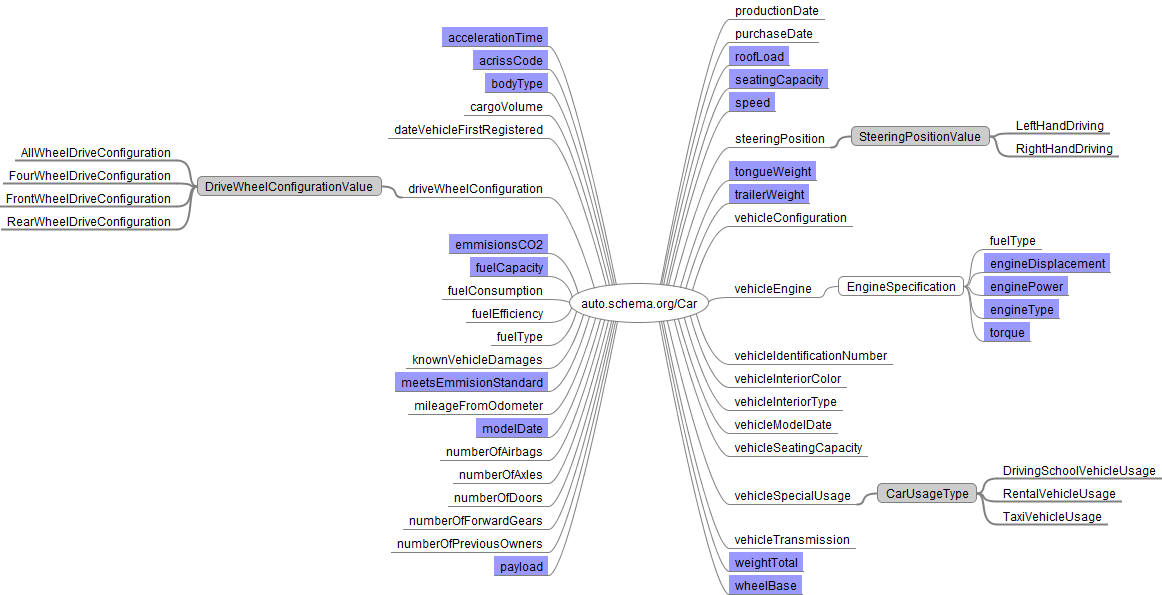
Key: Terms on a violet background are documented at auto.schema.org. All other terms are part of the core Schema.org vocabulary. The maps show extension properties for the Car type, which, along with BusOrCoach, Motorcycle, and MotorizedBicycle, is a subclass of the core Vehicle type.
图例:紫色背景上的术语在
auto.schema.org上有文档记录。所有其他术语是 Schema.org 核心词汇表的一部分。这些地图展示了Car类型的扩展属性,Car与BusOrCoach、Motorcycle和MotorizedBicycle一样,是核心Vehicle类型的子类。
Basic Data Models
The diagram below illustrates the fundamental pattern for describing the main object classes within the extension.
下图展示了描述扩展内主要对象类的基本模式。
Vehicle Type and Its Subtypes
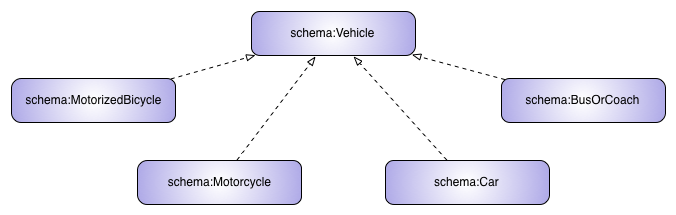
The top-level type for describing vehicles is Vehicle (a subtype of Product). Its most important specific subtypes are:
MotorizedBicycle(机动自行车)Motorcycle(摩托车)Car(汽车)BusOrCoach(巴士或长途客车)
Vehicle Type and Its Properties
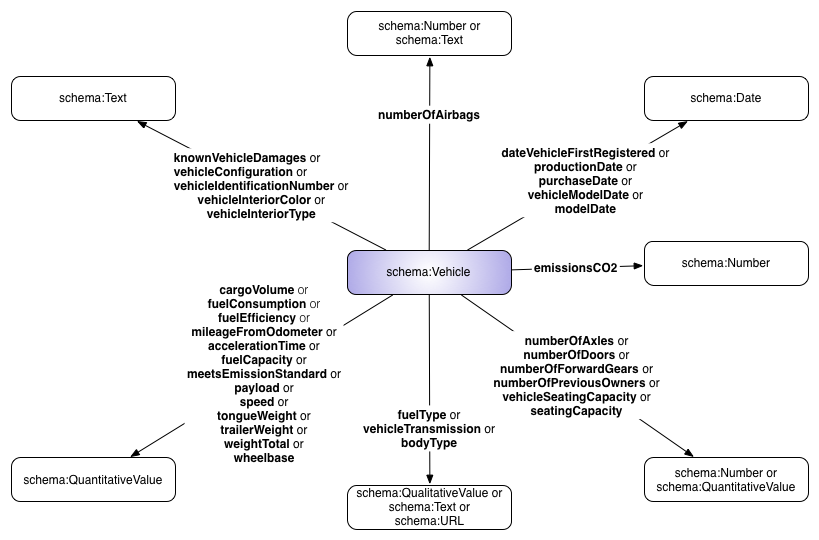
A vehicle can be described using numerous properties from the Schema.org core, such as vehicleIdentificationNumber (VIN), fuelType, numberOfDoors, and mileageFromOdometer. The auto.schema.org extension adds further specialized properties like accelerationTime, bodyType, emissionsCO2, and wheelbase to provide a richer description.
可以使用 Schema.org 核心中的众多属性来描述车辆,例如
vehicleIdentificationNumber (VIN)、fuelType、numberOfDoors和mileageFromOdometer。auto.schema.org 扩展添加了更多专业属性,如accelerationTime、bodyType、emissionsCO2和wheelbase,以提供更丰富的描述。
Car-Specific Properties: ACRISS Code and Roof Load
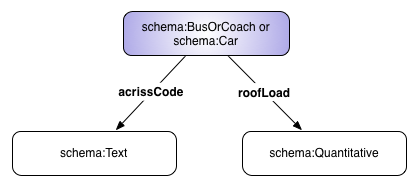
In addition to inheriting all properties from Vehicle, the Car and BusOrCoach types possess two extra properties specific to the auto.schema.org extension:
acrissCode: The ACRISS Car Classification Code, commonly used in the vehicle rental industry. (ACRISS 汽车分类代码,常用于汽车租赁行业。)roofLoad: The permitted total weight of cargo that can be safely placed on the roof of the vehicle. (可以安全放置在车顶的货物的允许总重量。)
除了继承
Vehicle的所有属性外,Car和BusOrCoach类型还拥有两个 auto.schema.org 扩展特有的额外属性:
acrissCode:ACRISS 汽车分类代码,常用于汽车租赁行业。roofLoad:可以安全放置在车顶的货物的允许总重量。
(Due to the length of the original content, this overview focuses on the foundational concepts. The subsequent sections on Drive Wheel Configuration, Engine Specifications, Usage Examples, and the complete hierarchy of terms follow the same structured, bilingual pattern, providing detailed models and practical markup samples for implementing automotive structured data.)
(由于原始内容篇幅较长,本概述侧重于基础概念。后续关于驱动轮配置、发动机规格、使用示例和完整术语层次结构的章节遵循相同的结构化双语模式,为实施汽车结构化数据提供了详细的模型和实用的标记示例。)
版权与免责声明:本文仅用于信息分享与交流,不构成任何形式的法律、投资、医疗或其他专业建议,也不构成对任何结果的承诺或保证。
文中提及的商标、品牌、Logo、产品名称及相关图片/素材,其权利归各自合法权利人所有。本站内容可能基于公开资料整理,亦可能使用 AI 辅助生成或润色;我们尽力确保准确与合规,但不保证完整性、时效性与适用性,请读者自行甄别并以官方信息为准。
若本文内容或素材涉嫌侵权、隐私不当或存在错误,请相关权利人/当事人联系本站,我们将及时核实并采取删除、修正或下架等处理措施。 也请勿在评论或联系信息中提交身份证号、手机号、住址等个人敏感信息。