中国火箭回收技术突破:垂直着陆与伞降双路径,2028年实现完全可重复使用
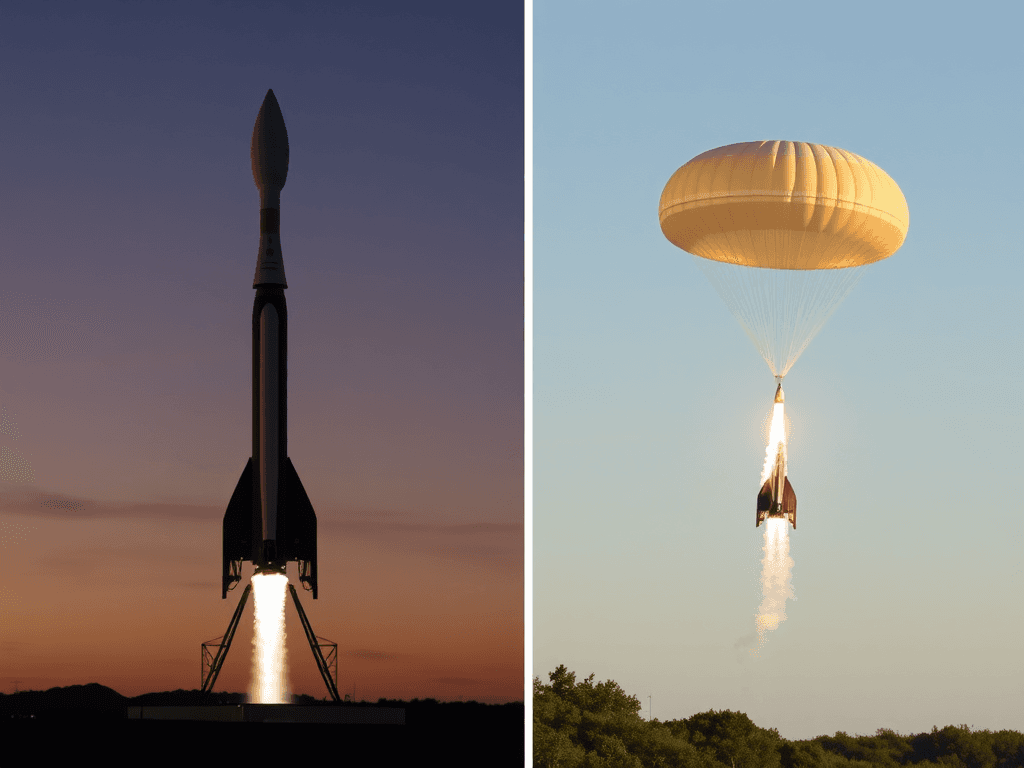
China's rocket recovery technology is advancing rapidly with multiple successful tests, aiming to reduce launch costs by 30-50% and achieve fully reusable orbital rockets by 2028-2030 through vertical landing and parachute approaches. (中国火箭回收技术快速发展,已成功进行多次测试,目标是通过垂直着陆和伞降方法将发射成本降低30-50%,并在2028-2030年实现完全可重复使用轨道火箭。)
中国火箭回收技术发展现状 (Current Status of China's Rocket Recovery Technology)
China's rocket recovery technology has entered a critical phase of rapid development, with multiple aerospace enterprises and research institutions achieving significant breakthroughs in recent years. According to industry reports, China has successfully conducted several vertical landing tests of reusable rocket prototypes, laying a solid technical foundation for future commercial applications.
中国火箭回收技术已进入快速发展关键阶段,近年来多家航天企业和研究机构取得重要突破。根据行业报告,中国已成功进行多次可重复使用火箭原型机的垂直着陆测试,为未来商业化应用奠定了坚实技术基础。
核心技术路径与挑战 (Core Technical Pathways and Challenges)
垂直着陆技术火箭回收的主流技术路径,通过精确控制发动机推力、下降过程中的气动稳定性以及着陆腿展开机制,实现火箭的垂直软着陆。 (Vertical Landing Technology)
Vertical landing technology is currently the mainstream approach for rocket recovery globally. This technology requires precise control of engine thrust, aerodynamic stability during descent, and landing leg deployment mechanisms. Key technical challenges include:
- Throttleable engine development for precise landing control. (可节流发动机能够调节推力的火箭发动机,是实现精确垂直着陆的关键技术之一,允许在下降过程中动态调整推力。开发以实现精确着陆控制)
- Navigation, guidance and control systems for autonomous landing. (用于自主着陆的导航、制导与控制系统)
- Thermal protection systems for re-entry heating. (用于再入加热的热防护系统A thermal protection system designed to shield reusable rocket stages from extreme heat generated during atmospheric re-entry.)
- Structural durability for multiple reuse cycles. (用于多次重复使用周期的结构耐久性)
伞降回收技术火箭回收的替代方法,通过在特定高度展开降落伞减缓下降速度,并配合气囊等缓冲系统实现安全着陆。 (Parachute Recovery Technology)
Parachute-based recovery represents an alternative approach that has been successfully implemented by some Chinese aerospace companies. This method involves:
- Deploying parachutes at specific altitudes to slow descent. (在特定高度展开降落伞以减缓下降速度)
- Using airbags or other cushioning systems for final touchdown. (使用气囊或其他缓冲系统进行最终触地)
- Recovery and refurbishment of rocket components. (火箭部件的回收与翻新)
主要参与机构与项目 (Major Participating Institutions and Projects)
According to industry analysis, several key players are driving China's rocket recovery technology development:
- China Aerospace Science and Technology Corporation (CASC) - Developing the Long March 8 reusable variant. (中国航天科技集团 - 开发长征八号可重复使用型号)
- China Aerospace Science and Industry Corporation (CASIC) - Working on the Kuaizhou reusable rocket series. (中国航天科工集团 - 研发快舟可重复使用火箭系列)
- Private aerospace companies including LandSpace, i-Space, and Galactic Energy, each pursuing different recovery approaches. (包括蓝箭航天、星际荣耀、星河动力在内的民营航天企业,各自采用不同的回收方法)
- University research teams from Beihang University, Harbin Institute of Technology, and others contributing to fundamental research. (北京航空航天大学、哈尔滨工业大学等高校研究团队参与基础研究)
经济与战略意义 (Economic and Strategic Significance)
The successful development of rocket recovery technology holds profound implications for China's space industry:
Rocket recovery technology could reduce launch costs by 30-50% according to industry estimates, making space access more affordable and stimulating downstream applications. This aligns with China's broader goals of building a self-reliant space industry and supporting national economic development objectives.
根据行业估算,火箭回收技术可将发射成本降低30-50%,使太空进入更加经济实惠并刺激下游应用。这与中国建设自主可控航天产业和支持国家经济发展目标的更广泛目标相一致。
未来展望与发展路线图 (Future Outlook and Development Roadmap)
Industry experts project that China will achieve its first fully reusable orbital rocket launch by 2028-2030, with incremental milestones including:
- 2025-2026: Suborbital test flights with full recovery. (2025-2026年:实现完全回收的亚轨道试飞)
- 2027-2028: Orbital missions with first stage recovery. (2027-2028年:实现一级回收的轨道任务)
- 2029-2030: Complete two-stage recovery capability. (2029-2030年:实现两级完全回收能力)
Frequently Asked Questions (常见问题)
What is the current status of China's rocket recovery technology?
中国火箭回收技术目前处于快速发展阶段,已成功进行多次垂直着陆测试,多家企业和研究机构在不同技术路径上取得进展,预计2025-2026年实现亚轨道完全回收试飞。
Which Chinese companies are leading in rocket recovery development?
中国航天科技集团、中国航天科工集团以及蓝箭航天、星际荣耀、星河动力等民营航天企业都在积极推进火箭回收技术研发,各自采用不同的技术路线。
How much cost reduction can rocket recovery achieve?
根据行业估算,火箭回收技术可将单次发射成本降低30-50%,具体取决于回收次数、翻新成本和任务类型等因素。
What are the main technical challenges for rocket recovery?
主要技术挑战包括可节流发动机能够调节推力的火箭发动机,是实现精确垂直着陆的关键技术之一,允许在下降过程中动态调整推力。开发、精确制导与控制、热防护系统A thermal protection system designed to shield reusable rocket stages from extreme heat generated during atmospheric re-entry.设计、结构耐久性以及快速检测与翻新流程等。
When will China achieve fully reusable orbital rockets?
行业专家预测中国将在2028-2030年实现首次完全可重复使用轨道火箭发射,之前将有多个阶段性里程碑。
版权与免责声明:本文仅用于信息分享与交流,不构成任何形式的法律、投资、医疗或其他专业建议,也不构成对任何结果的承诺或保证。
文中提及的商标、品牌、Logo、产品名称及相关图片/素材,其权利归各自合法权利人所有。本站内容可能基于公开资料整理,亦可能使用 AI 辅助生成或润色;我们尽力确保准确与合规,但不保证完整性、时效性与适用性,请读者自行甄别并以官方信息为准。
若本文内容或素材涉嫌侵权、隐私不当或存在错误,请相关权利人/当事人联系本站,我们将及时核实并采取删除、修正或下架等处理措施。 也请勿在评论或联系信息中提交身份证号、手机号、住址等个人敏感信息。