机器学习知识图谱包含哪些核心概念?(附206节点详解)
AI Summary (BLUF)
This article presents a comprehensive knowledge graph mapping 206 interconnected concepts across mathematics, statistics, machine learning, optimization, and artificial intelligence, providing a structured curriculum for navigating the complex ML landscape.
原文翻译: 本文展示了一个全面的知识图谱,涵盖了数学、统计学、机器学习、优化和人工智能领域的206个相互关联的概念,为导航复杂的机器学习领域提供了结构化课程。
Introduction
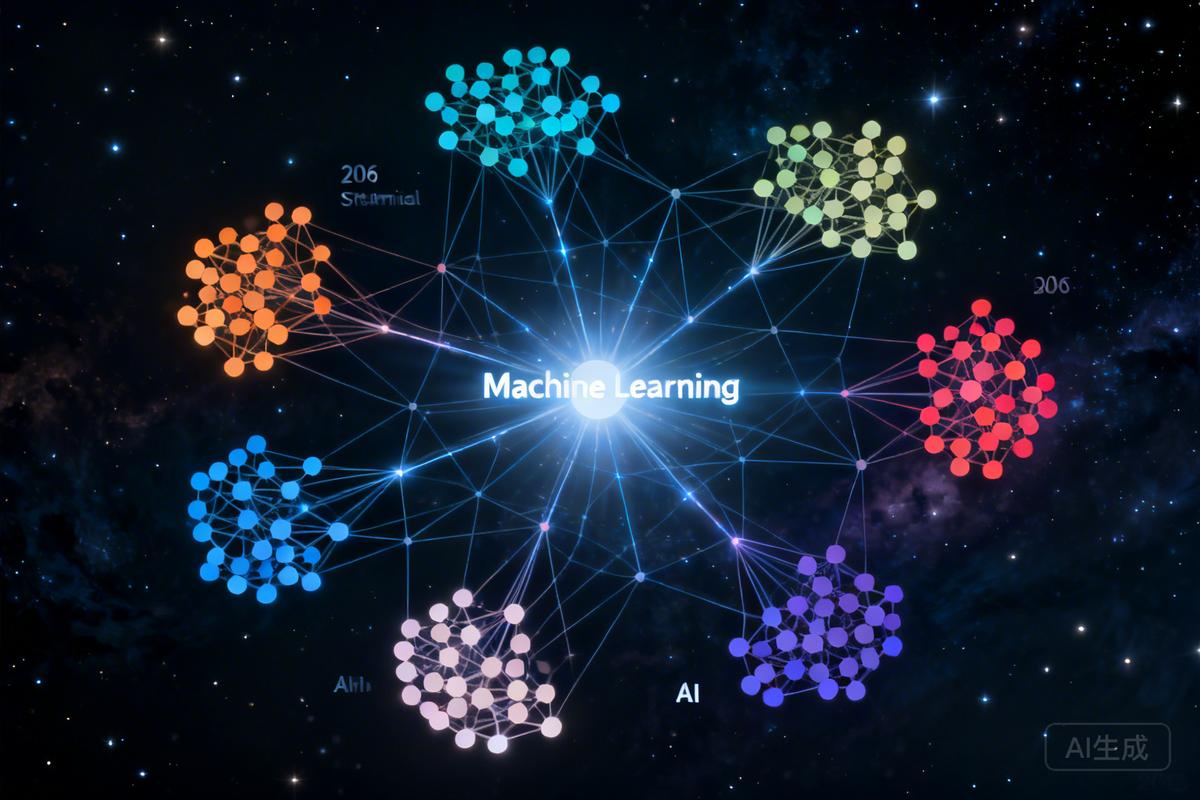
Machine learning emerges from the intersection of many fields of study. Important concepts in these areas are related in many ways. The aim with this graph is to highlight the connections between those concepts and, hopefully, help us navigate this complex idea space. Currently, the graph has 206 nodes and 278 edges.
机器学习A subset of AI that enables systems to learn patterns and improve from data without explicit programming.诞生于多个研究领域的交叉点。这些领域中的重要概念以多种方式相互关联。构建此知识图谱A structured knowledge base that represents entities and their relationships in a graph format.的目的在于揭示这些概念之间的联系,并帮助我们在这个复杂的思想空间中导航。目前,该图谱包含 206 个节点和 278 条边。
The concepts were classified in 5 categories:
- Mathematics
- Statistics
- Machine Learning
- Optimization
- Artificial Intelligence
这些概念被分为 5 大类:
- 数学
- 统计学
- 机器学习A subset of AI that enables systems to learn patterns and improve from data without explicit programming.
- 优化
- 人工智能
A category called "Other" was added to list important related research areas. Some concepts lie on the intersection of fields and are hard to classify. An effort was made to put them where they are used more frequently. The topics covered on the graph are listed below.
此外,还添加了一个名为“其他”的类别,用于列出重要的相关研究领域。有些概念位于多个领域的交叉点,难以严格分类。我们努力将其归类于其更常被使用的领域。图谱涵盖的主题如下所列。
Core Curriculum & Knowledge Structure
The following structured curriculum outlines the interconnected domains that form the foundation of machine learning. This bilingual list mirrors the hierarchical organization of the original knowledge graph.
以下结构化课程大纲概述了构成机器学习A subset of AI that enables systems to learn patterns and improve from data without explicit programming.基础的相互关联的领域。这个双语列表反映了原始知识图谱A structured knowledge base that represents entities and their relationships in a graph format.的层次化组织。
Mathematics
- Set theory (集合论)
- Empty set (空集)
- Finite and infinite sets (有限集与无限集)
- Operations on sets (集合运算)
- Complement (补集)
- Union (并集)
- Intersection (交集)
- Sigma-algebra (σ-代数)
- Algebra (代数)
- Linear Algebra (线性代数)
- Matrix transformation (矩阵变换)
- Eigenstuff (特征值与特征向量)
- Matrix decomposition (矩阵分解)
- Singular Value Decomposition (奇异值分解)
- Non-negative Matrix Factorization (非负矩阵分解)
- Abstract Algebra (抽象代数)
- Linear Algebra (线性代数)
- Calculus (微积分)
- Limits (极限)
- Derivatives (导数)
- Partial derivatives (偏导数)
- Gradient (梯度)
- Partial derivatives (偏导数)
- Integrals (积分)
- Taylor series (泰勒级数)
- Maclaurin series (麦克劳林级数)
- Fourier series (傅里叶级数)
- Fourier transform (傅里叶变换)
- Laplace transform (拉普拉斯变换)
- Fourier transform (傅里叶变换)
- Topology (拓扑学)
- Algebraic topology (代数拓扑学)
- Manifolds (流形)
- Algebraic topology (代数拓扑学)
Optimization
- Combinatorial Optimization (组合优化)
- Branch and Bound (分支定界法)
- Convex Optimization (凸优化)
- Linear Programming (线性规划)
- Simplex (单纯形法)
- Linear Programming (线性规划)
- Iterative methods (迭代方法)
- Newton's method (牛顿法)
- Gradient descent (梯度下降创建LLM的数学优化过程,遵循精确的数学定律,是这些'外星文物'实际上的'建造者'。)
- Expectation Maximization (期望最大化算法)
- Baum-Welch algorithm (鲍姆-韦尔奇算法)
- Heuristics (启发式方法)
- Evolutionary algorithms (进化算法)
Probability
- Sample Space (样本空间)
- Kolmogorov axioms (柯尔莫哥洛夫公理)
- Cox's theorem (考克斯定理)
- Relative frequency and probability (相对频率与概率)
- Counting methods (计数方法)
- Multiplication rule (乘法原理)
- Permutation (排列)
- Combination and Binomial coefficient (组合与二项式系数)
- Arrangement (排列(有重复))
- Conditional probability (条件概率)
- Bayes' Theorem (贝叶斯定理概率论中的基本定理,用于在已知先验概率和条件概率的情况下更新事件概率,公式为 P(A|B) = [P(B|A) * P(A)] / P(B)。)
- Posterior probability distribution (后验概率分布)
- Random Variables (随机变量)
- Algebra of random variables (随机变量的代数运算)
- Expected value (期望值)
- Variance (方差)
- Distributions (分布)
- Exponential family (指数族分布)
- Normal distribution (正态分布)
- Bernoulli distribution (伯努利分布)
- Moment-generating function (矩生成函数)
- Characteristic function (特征函数)
- Multivariate distributions (多元分布)
- Joint distribution (联合分布)
- Marginal distribution (边缘分布)
- Conditional distribution (条件分布)
- Exponential family (指数族分布)
- Probability inequalities (概率不等式)
- Chebyshev's inequality (切比雪夫不等式)
- Bernstein inequalities (伯恩斯坦不等式)
- Chernoff bound (切尔诺夫界)
- Hoeffding's inequality (霍夫丁不等式)
Statistics
- Sampling distribution (抽样分布)
- Law of large numbers (大数定律)
- Central Limit Theorem (中心极限定理)
- Resampling (重采样)
- Jackknife (刀切法)
- Bootstrap (自助法)
- Monte Carlo method (蒙特卡洛方法)
- Likelihood function (似然函数)
- Random Field (随机场)
- Stochastic process (随机过程)
- Time-series analysis (时间序列分析)
- Markov Chain (马尔可夫链)
- Stochastic process (随机过程)
- Inference (推断)
- Hypothesis testing (假设检验)
- ANOVA (方差分析)
- Survival analysis (生存分析)
- Non-parametric (非参数方法)
- Kaplan–Meier (卡普兰-迈耶估计量)
- Nelson-Aalen (纳尔逊-艾伦估计量)
- Parametric (参数方法)
- Cox regression (考克斯回归)
- Non-parametric (非参数方法)
- Properties of estimators (估计量的性质)
- Quantified properties (量化性质)
- Error (误差)
- Mean squared error (均方误差)
- Bias and Variance (偏差与方差)
- Unbiased estimator (无偏估计量)
- Minimum-variance unbiased estimator (MVUE) (最小方差无偏估计量)
- Cramér-Rao bound (克拉默-拉奥下界)
- Unbiased estimator (无偏估计量)
- Bias-variance tradeoff (偏差-方差权衡)
- Error (误差)
- Behavioral properties (行为性质)
- Asymptotic properties (渐近性质)
- Asymptotic normality (渐近正态性)
- Consistency (相合性)
- Efficiency (有效性)
- Robustness (稳健性)
- M-estimators (M估计量)
- Asymptotic properties (渐近性质)
- Quantified properties (量化性质)
- Multivariate analysis (多元分析)
- Covariance matrix (协方差矩阵)
- Dimensionality reduction (降维)
- Feature selection (特征选择)
- Filter methods (过滤式方法)
- Wrapper methods (封装式方法)
- Embedded methods (嵌入式方法)
- Feature extraction (特征提取)
- Linear (线性方法)
- Principal Component Analysis (主成分分析)
- Linear Discriminant Analysis (线性判别分析)
- Nonlinear (非线性方法)
- t-SNE (t-分布随机邻域嵌入)
- UMAP (均匀流形逼近与投影)
- Linear (线性方法)
- Feature selection (特征选择)
- Factor Analysis (因子分析)
- Mixture models (混合模型)
- Method of moments (矩估计法)
- Spectral method (谱方法)
- Parametric inference (参数推断)
- Regression (回归)
- Linear regression (线性回归)
- Quantile regression (分位数回归)
- Autoregressive models (自回归模型)
- Generalized Linear Models (广义线性模型)
- Logistic regression (逻辑回归)
- Multinomial regression (多项回归)
- Regression (回归)
- Bayesian Inference (贝叶斯推断)
- Sampling Bayesian Methods (采样贝叶斯方法)
- MCMC (马尔可夫链蒙特卡洛)
- Hamiltonian Monte Carlo (哈密顿蒙特卡洛)
- MCMC (马尔可夫链蒙特卡洛)
- Approximate Bayesian Methods (近似贝叶斯方法)
- Variational inference (变分推断)
- Integrated Nested Laplace Approximation (集成嵌套拉普拉斯近似)
- Maximum a posteriori estimation (最大后验估计)
- Sampling Bayesian Methods (采样贝叶斯方法)
- Probabilistic Graphical Models (概率图模型)
- Bayesian Networks (贝叶斯网络)
- Hidden Markov Models (隐马尔可夫模型)
- Markov Random Field (马尔可夫随机场)
- Boltzmann machine (玻尔兹曼机)
- Latent Dirichlet Allocation (潜在狄利克雷分配)
- Conditional Random Field (条件随机场)
- Bayesian Networks (贝叶斯网络)
- Nonparametric inference (非参数推断)
- Additive models (加性模型)
- Generalized additive models (广义加性模型)
- Kernel density estimation (核密度估计)
- Additive models (加性模型)
- Generative and discriminative models (生成式与判别式模型)
- Hypothesis testing (假设检验)
Machine Learning
- Statistical Learning Theory (统计学习理论)
- Vapnik-Chervonenkis theory (VC理论)
- Hypothesis set (假设集)
- Inductive bias (归纳偏置)
- No free lunch theorem (没有免费午餐定理)
- Inductive bias (归纳偏置)
- Loss function (损失函数)
- Regularization (正则化)
- LASSO (LASSO回归)
- Ridge (岭回归)
- Elastic Net (弹性网络)
- Early stopping (早停法)
- Dropout (随机失活)
- Cross-validation (交叉验证)
- Hyperparameter optimization (超参数优化)
- Automated Machine Learning (自动化机器学习A subset of AI that enables systems to learn patterns and improve from data without explicit programming.)
- k-NN (k近邻算法)
- Naive Bayes (朴素贝叶斯)
- Support Vector Machines (支持向量机)
- Kernel trick (核技巧)
- Decision trees (决策树)
- Random Forest (随机森林)
- Neural Networks (神经网络一种模仿生物神经网络结构和功能的计算模型,是AI模型的基础架构。它由大量互联的神经元(节点)组成,通过调整神经元之间的连接参数(权重)来学习数据中的模式。)
- Training (训练)
- Backpropagation (反向传播)
- Activation function (激活函数)
- Sigmoid (Sigmoid函数)
- Softmax (Softmax函数)
- Tanh (双曲正切函数)
- ReLU (线性整流函数)
- Architecture (架构)
- Feedforward networks (前馈网络)
- Perceptron (感知机)
- Multilayer perceptron (多层感知机)
- Convolutional Neural Networks (卷积神经网络一种模仿生物神经网络结构和功能的计算模型,是AI模型的基础架构。它由大量互联的神经元(节点)组成,通过调整神经元之间的连接参数(权重)来学习数据中的模式。)
- Deep Q-Learning (深度Q学习)
- Temporal Convolutional Networks (时序卷积网络)
- Convolutional Neural Networks (卷积神经网络一种模仿生物神经网络结构和功能的计算模型,是AI模型的基础架构。它由大量互联的神经元(节点)组成,通过调整神经元之间的连接参数(权重)来学习数据中的模式。)
- Autoencoder (自编码器)
- Variational autoencoder (变分自编码器)
- Recurrent networks (循环网络)
- LSTM (长短期记忆网络)
- Hopfield networks (霍普菲尔德网络)
- Restricted Boltzmann machine (受限玻尔兹曼机)
- Deep Belief Network (深度信念网络)
- Feedforward networks (前馈网络)
- Training (训练)
- Adversarial Machine Learning (对抗性机器学习A subset of AI that enables systems to learn patterns and improve from data without explicit programming.)
- Generative Adversarial Networks (生成对抗网络)
- Ensemble (集成学习)
- Bagging (袋装法)
- Boosting (提升法)
- Stacking (堆叠法)
- Meta-learning (元学习)
- Sequence models (序列模型)
Artificial Intelligence
- Symbolic AI (符号人工智能)
- Logic-based AI (基于逻辑的人工智能)
- Automated reasoning (自动推理)
- Logic-based AI (基于逻辑的人工智能)
- Search Problems (搜索问题)
- A* search algorithm (A*搜索算法)
- Decision Theory (决策理论)
- Game Theory (博弈论)
- Zero-sum game (零和博弈)
- Minimax (极小化极大算法)
- Non-zero-sum game (非零和博弈)
- Zero-sum game (零和博弈)
- Game Theory (博弈论)
- Cybernetics (控制论)
- Computer vision (计算机视觉)
- Robotics (机器人学)
- Natural Language Processing (自然语言处理)
- Language model (语言模型)
- Unigram model (一元模型)
- Topic model (主题模型)
- Text classification (文本分类)
- Sentiment analysis (情感分析)
- Word representation (词表示)
- Bag-of-words (词袋模型)
- Word embedding (词嵌入)
- Word2vec (Word2vec)
- Latent Semantic Analysis (潜在语义分析)
- Text classification (文本分类)
- Natural Language Understanding (自然语言理解)
- Speech recognition (语音识别)
- Question answering AI (问答AI)
- Text summarization (文本摘要)
- Machine translation (机器翻译)
- Information Retrieval (IR) (信息检索)
- Probabilistic IR models (概率信息检索模型)
- Information filtering system (信息过滤系统)
- Recommender system (推荐系统)
- Collaborative filtering (协同过滤)
- Content-based filtering (基于内容的过滤)
- Hybrid recommender systems (混合推荐系统)
- Recommender system (推荐系统)
- Turing test (图灵测试)
- Language model (语言模型)
Other
- Complexity Theory (复杂性理论)
- Statistical physics (统计物理学)
- Hamiltonian mechanics (哈密顿力学)
- Ising model (伊辛模型)
- Information Theory (信息论)
- Entropy (熵)
- Kullback–Leibler divergence (KL散度)
- Signal processing (信号处理)
- Kalman filter (卡尔曼滤波器)
Key Methodologies & Conceptual Comparisons
To better understand the relationships and trade-offs between different concepts within the knowledge graph, the following tables provide a structured comparison of core methodologies across key domains.
Optimization Algorithms: A Comparative Overview
| Algorithm Category | Key Characteristics | Typical Use Cases | Strengths | Limitations |
|---|---|---|---|---|
| Gradient Descent | Iterative, first-order optimization using gradients. | Training neural networks, convex optimization. | Simple, scalable to large datasets. | Can get stuck in local minima, sensitive to learning rate. |
| Newton's Method | Iterative, second-order optimization using Hessian matrix. | Small to medium-scale convex problems. | Faster convergence (quadratic) near optimum. | Computationally expensive (Hessian calculation/inversion), may not converge for non-convex problems. |
| Expectation Maximization (EM) | Iterative method for finding maximum likelihood estimates with latent variables. | Mixture models (e.g., GMM), Hidden Markov Models. | Guaranteed to increase likelihood each iteration. | Can converge to local maxima, slow convergence. |
| Evolutionary Algorithms | Population-based, heuristic search inspired by biological evolution. | Non-differentiable, complex, or black-box optimization. | Does not require gradient information, good for global search. | Computationally intensive, convergence not guaranteed. |
Dimensionality Reduction Techniques
| Technique | Category | Key Principle | Linearity | Primary Goal |
|---|---|---|---|---|
| Principal Component Analysis (PCA) | Feature Extraction | Finds orthogonal directions of maximum variance in data. | Linear | Unsupervised dimensionality reduction, noise reduction. |
| Linear Discriminant Analysis (LDA) | Feature Extraction | Finds axes that maximize separation between classes. | Linear | Supervised dimensionality reduction for classification. |
| t-SNE | Feature Extraction | Minimizes divergence between high-dim and low-dim probability distributions. | Nonlinear | Visualization of high-dimensional data in 2D/3D. |
| UMAP | Feature Extraction | Models data on a Riemannian manifold and projects to lower dimensions. | Nonlinear | Visualization and general-purpose non-linear reduction. |
| LASSO Regression | Feature Selection (Embedded) | Adds L1 penalty to regression, driving some coefficients to zero. | Linear | Model simplification, feature selection, handling multicollinearity. |
Neural Network Activation Functions
| Function | Formula (Typical) | Range | Advantages | Disadvantages |
|---|---|---|---|---|
| Sigmoid | σ(x) = 1 / (1 + e^{-x}) | (0, 1) | Smooth gradient, outputs can be interpreted as probabilities. | Prone to vanishing gradients, outputs not zero-centered. |
| Tanh | tanh(x) = (e^x - e^{-x}) / (e^x + e^{-x}) | (-1, 1) | Zero-centered, stronger gradient than sigmoid near zero. | Still suffers from vanishing gradients for extreme inputs. |
<
常见问题(FAQ)这个知识图谱A structured knowledge base that represents entities and their relationships in a graph format.包含哪些主要学科领域?该图谱涵盖数学、统计学、机器学习A subset of AI that enables systems to learn patterns and improve from data without explicit programming.、优化和人工智能五大核心领域,共映射了206个相互关联的概念,为理解复杂的机器学习A subset of AI that enables systems to learn patterns and improve from data without explicit programming.知识体系提供了结构化框架。 知识图谱A structured knowledge base that represents entities and their relationships in a graph format.如何帮助我学习机器学习A subset of AI that enables systems to learn patterns and improve from data without explicit programming.?图谱通过278条边清晰展示概念间的联系,并按照核心课程结构(如数学基础、优化方法、概率统计等)组织内容,帮助学习者系统性地导航整个知识体系。 图谱中的概念分类标准是什么?概念主要按使用频率较高的领域归类,部分交叉概念难以严格分类。除五大核心类别外,还设有“其他”类别收录相关研究领域,确保知识结构的完整性。 |
版权与免责声明:本文仅用于信息分享与交流,不构成任何形式的法律、投资、医疗或其他专业建议,也不构成对任何结果的承诺或保证。
文中提及的商标、品牌、Logo、产品名称及相关图片/素材,其权利归各自合法权利人所有。本站内容可能基于公开资料整理,亦可能使用 AI 辅助生成或润色;我们尽力确保准确与合规,但不保证完整性、时效性与适用性,请读者自行甄别并以官方信息为准。
若本文内容或素材涉嫌侵权、隐私不当或存在错误,请相关权利人/当事人联系本站,我们将及时核实并采取删除、修正或下架等处理措施。 也请勿在评论或联系信息中提交身份证号、手机号、住址等个人敏感信息。