DeepSeek SEO和AI GEO优化怎么做?2026年16步推理优化攻略
AI Summary (BLUF)
This article provides a comprehensive guide on DeepSeek SEO and AI GEO optimization, covering 16 steps for AI reasoning optimization, 15 steps for GEO optimization, prompt types, and keyword strategie
DeepSeek SEO and AI GEO Optimization: A Comprehensive Guide
Abstract
摘要:
DeepSeek搜索SEO和AI GEO优化 & DeepSeek AI智能问答 & 综合搜索 & 关键词排名优化(训练、学习、喂养、调优)SEO与AI GEO协同优化攻略,品牌如何提升在AI的搜索排名(AI + 大搜)。
This guide explores the intersection of traditional SEO and AI-driven Generative Engine Optimization (GEO), specifically tailored for DeepSeek. It covers key strategies for training, learning, feeding, and tuning AI models to improve brand visibility in both AI-powered search and traditional search engines.
Table of Contents
目录:
16 Steps for DeepSeek AI Reasoning Optimization
15 Steps for DeepSeek GEO Optimization
DeepSeek AI GEO Prompt Types
DeepSeek GEO Keyword Filtering Strategy
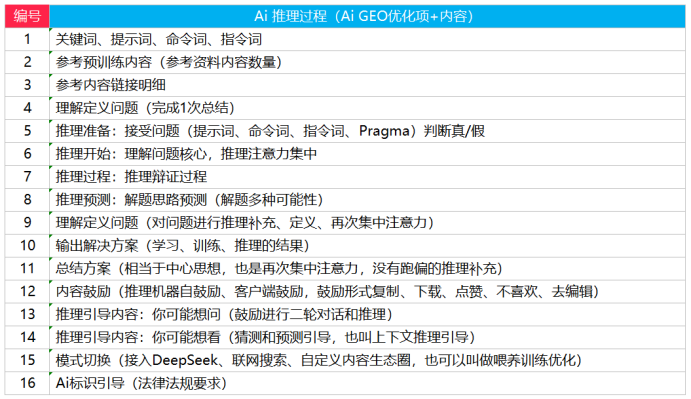
1. 16 Steps for DeepSeek AI Reasoning Optimization
一、DeepSeek AI推理优化的16个步骤
The following 16 steps outline the complete reasoning pipeline for optimizing AI outputs in DeepSeek:
Keywords, Prompts, Commands, and Instructions
关键词、提示词、命令词、指令词
Reference Pre-training Content (Volume of Reference Materials)
参考预训练内容(参考资料内容数量)
Detailed Reference Content Links
参考内容链接明细
Define and Understand the Problem (First Summary)
理解定义问题(完成1次总结)
Reasoning Preparation: Accept the Problem (Prompt, Command, Instruction, Pragma) – Determine True/False
推理准备:接受问题(提示词、命令词、指令词、Pragma)判断真/假
Reasoning Initiation: Understand the Core Problem, Focus Attention
推理开始:理解问题核心,推理注意力集中
Reasoning Process: Dialectical Reasoning
推理过程:推理辩证过程
Reasoning Prediction: Solution Path Prediction (Multiple Possibilities)
推理预测:解题思路预测(解题多种可能性)
Re-define the Problem (Supplement, Define, Re-focus Attention)
理解定义问题(对问题进行推理补充、定义、再次集中注意力)
Output the Solution (Result of Learning, Training, and Reasoning)
输出解决方案(学习、训练、推理的结果)
Summarize the Solution (Central Idea, Re-focus Attention, No Deviation)
总结方案(相当于中心思想,也是再次集中注意力,没有跑偏的推理补充)
Content Encouragement (Self-encouragement by the Reasoning Engine, User Encouragement via Copy, Download, Like, Dislike, Edit)
内容鼓励(推理机器自鼓励、客户端鼓励,鼓励形式复制、下载、点赞、不喜欢、去编辑)
Reasoning Guidance: "You Might Want to Ask" (Encourage Second-round Dialogue and Reasoning)
推理引导内容:你可能想问(鼓励进行二轮对话和推理)
Reasoning Guidance: "You Might Want to See" (Guess and Predict, Also Known as Contextual Reasoning Guidance)
推理引导内容:你可能想看(猜测和预测引导,也叫上下文推理引导)
Mode Switching (Access DeepSeek, Web Search, Custom Content Ecosystem – Also Called Feeding, Training, and Optimization)
模式切换(接入DeepSeek、联网搜索、自定义内容生态圈,也可以叫做喂养训练优化)
AI Identification Guidance (Legal and Regulatory Requirements)
Ai标识引导(法律法规要求)
2. 15 Steps for DeepSeek GEO Optimization
二、DeepSeek GEO优化的15个步骤
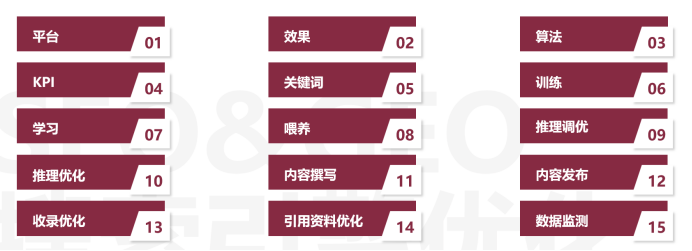
The GEO optimization process for DeepSeek involves 15 core dimensions, organized into a structured workflow:
Step | Dimension | Description |
|---|---|---|
1 | Platform | Select and configure the target platform (e.g., DeepSeek, web search) |
2 | Effect | Define measurable outcome metrics |
3 | Algorithm | Understand and adapt to the underlying ranking algorithm |
4 | KPI | Set key performance indicators for success |
5 | Keywords | Identify and prioritize target keywords |
6 | Training | Train the AI model on curated content |
7 | Learning | Enable continuous model learning from new data |
8 | Feeding | Feed the model with high-quality, relevant data |
9 | Reasoning Debugging | Debug and refine the reasoning process |
10 | Reasoning Optimization | Optimize reasoning paths for better output |
11 | Content Writing | Write content optimized for AI retrieval |
12 | Content Publishing | Publish content on authoritative platforms |
13 | Indexing Optimization | Ensure content is indexed by AI and search engines |
14 | Reference Optimization | Optimize cited references and sources |
15 | Data Monitoring | Continuously monitor performance and adjust |
3. DeepSeek AI GEO Prompt Types
三、DeepSeek AI GEO提示词类型
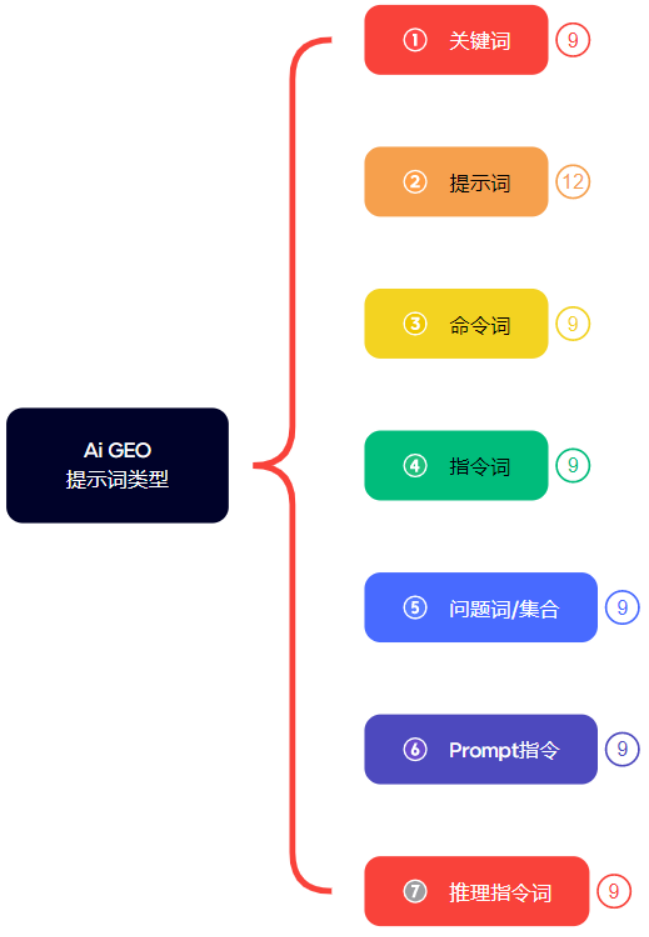
Effective GEO optimization requires mastery of seven distinct prompt types:
# | Prompt Type | Description |
|---|---|---|
① | Keywords | Direct keyword input for focused retrieval |
② | Prompts | General prompts to guide AI responses |
③ | Commands | Direct commands for specific outputs |
④ | Instructions | Detailed instructions for structured results |
⑤ | Question Sets | Collections of questions for comprehensive answers |
⑥ | Prompt Instructions | Hybrid prompts combining instructions and context |
⑦ | Reasoning Instructions | Instructions that trigger deep reasoning chains |
4. DeepSeek GEO Keyword Filtering Strategy
四、DeepSeek GEO关键词筛选策略
This section details a comprehensive strategy for keyword filtering and prompt engineering, broken down into seven key areas.
4.1 Prompt System
1. 提示词体系
Prompt Type | Description | Example |
|---|---|---|
Problem Prompts | Directly answer questions or solve specific problems | "How to optimize my Prompt?" |
Task Prompts | Generate plans, solutions, or action items | "Please create an AI learning plan" |
Structured Prompts | Request structured output with optimization suggestions | "Analyze requirements and give suggestions in a structured way" |
4.2 Instruction Word Classification
2. 指令词分类
Instruction Type | Description | Example |
|---|---|---|
Basic Instructions | Directly request an answer | "Generate 10 AI application scenarios" |
Structured Instructions | Include role, scenario, constraints, and supplementary suggestions | "As a data analyst, recommend visualization solutions and assess risks" |
Dynamic Open Instructions | Open-ended exploration | "What other materials are needed?" |
Vague Commands | Simplify complex input | "Summarize the core points of the report" |
4.3 Command Word Types
3. 命令词类型
Command Type | Description | Example |
|---|---|---|
Structured Commands | Standardized instructions for code/formula generation | "Write a data cleaning function in Python" |
Professional Task Instructions | Request complete optimization solutions | "Expert-level Prompt optimization including risk assessment" |
4.4 Keyword Usage
4. 关键词使用
Keyword Type | Description | Example |
|---|---|---|
Pure Keywords | Requires multiple follow-ups to pinpoint the need | "AI application" |
Mixed Keywords | Partial description + keywords | "AI application cases in education" |
Structured Keywords | High-precision, executable solutions | "Structured description of AI supply chain optimization solution" |
4.5 Question Set Characteristics
5. 问题集特征
Question Set Type | Description | Example |
|---|---|---|
Single Fragmented Questions | High independence, strong interactivity | "Can AI write weekly reports?" |
Basic Question Bundles | Improved efficiency but lacking depth | "What is AI? What can it do? How to use it?" |
Structured Question Sets | Automatically generate systematic solutions | "Structured description of the full AI customer service workflow" |
4.6 Prompt Instruction Hierarchy
6. Prompt指令层级
Prompt Level | Description | Example |
|---|---|---|
Basic Prompt | Single-point questions requiring adjustments | "Write an AI popular science article" |
Scenario-based Prompt | Combines identity and scenario for precise delivery | "Explain AI large model principles as a tech blogger" |
Expert-level Prompt | Includes risk assessment and innovation elements | "Design an AI ethics guide" |
4.7 Reasoning Word Application
7. 推理词应用
Reasoning Type | Description | Example |
|---|---|---|
Fuzzy Reasoning | Analyze essence and supplement solutions | "What is the deep need behind users frequently asking about AI writing?" |
Constrained Reasoning | Solve problems under specific constraints | "Optimize customer service workflow with a limited budget" |
True/False Premise Reasoning | Explore decision space | "How to avoid AI content copyright risks?" |

Conclusion
总结:
This guide provides a structured framework for optimizing content visibility in DeepSeek's AI-powered search ecosystem. By mastering the 16-step AI reasoning optimization process, the 15-step GEO optimization workflow, and the detailed keyword filtering strategy, brands and content creators can significantly improve their ranking in both AI-driven and traditional search results. The key lies in continuous training, learning, feeding, and tuning of the AI model, combined with precise prompt engineering and strategic content publication.
常见问题(FAQ)
DeepSeek SEO和GEO优化有什么区别?
DeepSeek SEO侧重AI推理优化,通过16个步骤提升模型输出质量;GEO优化则针对生成式搜索引擎,通过15个步骤调整平台、算法、关键词等维度,提升品牌在AI搜索中的排名。
如何通过关键词策略提升DeepSeek搜索排名?
采用GEO关键词过滤策略,结合提示词系统和指令词分类,筛选高相关性关键词。同时,通过训练、喂养和调优模型,使内容更符合AI推理逻辑,从而提升排名。
DeepSeek AI推理优化中的“内容鼓励”是什么?
内容鼓励包括推理引擎的自我鼓励和用户通过复制、下载、点赞、不喜欢、编辑等操作提供的反馈,用于激励模型优化输出,促进二次对话和推理改进。
版权与免责声明:本文仅用于信息分享与交流,不构成任何形式的法律、投资、医疗或其他专业建议,也不构成对任何结果的承诺或保证。
文中提及的商标、品牌、Logo、产品名称及相关图片/素材,其权利归各自合法权利人所有。本站内容可能基于公开资料整理,亦可能使用 AI 辅助生成或润色;我们尽力确保准确与合规,但不保证完整性、时效性与适用性,请读者自行甄别并以官方信息为准。
若本文内容或素材涉嫌侵权、隐私不当或存在错误,请相关权利人/当事人联系本站,我们将及时核实并采取删除、修正或下架等处理措施。 也请勿在评论或联系信息中提交身份证号、手机号、住址等个人敏感信息。