TurboQuant如何压缩KV缓存?2026年AI推理加速技术解析

Google Research's TurboQuant algorithm compresses LLM KV cache to 3-bit precision, achieving 6x memory reduction and up to 8x inference acceleration on H100 GPUs with zero precision loss, revolutionizing long-context AI efficiency.
原文翻译: Google Research的TurboQuant算法将LLM KV缓存压缩至3位精度,在H100 GPU上实现6倍内存缩减和最高8倍推理加速,且无精度损失,彻底改变了长上下文AI的效率。
大语言模型在处理长文本时面临一个关键瓶颈:随着上下文长度增加,KV缓存(Key-Value Cache)会迅速占满GPU显存,严重限制推理吞吐量和并发能力。Google Research最新发布的TurboQuant算法,正是针对这一核心痛点而来。
Large language models face a critical bottleneck when processing long texts: as the context length increases, the Key-Value (KV) Cache rapidly consumes GPU memory, severely limiting inference throughput and concurrency. The newly released TurboQuant algorithm from Google Research directly addresses this core challenge.
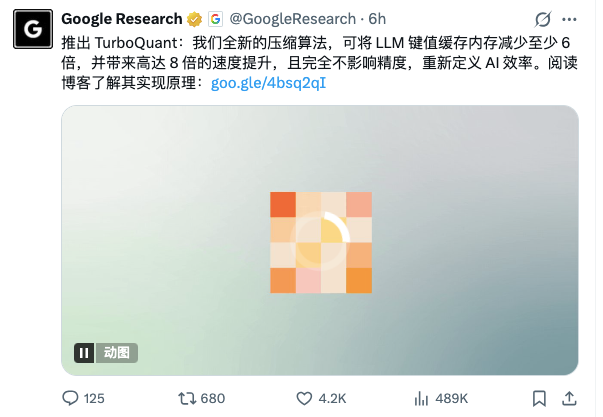
什么是 TurboQuant?
TurboQuant是Google Research开发的一种在线向量量化压缩算法,专门用于压缩LLM推理过程中的KV缓存。它能将KV缓存量化至3bit精度,实现至少6倍的内存压缩,同时在H100 GPU上带来最高8倍的注意力计算加速——而这一切以零精度损失为代价,无需额外训练或微调。
TurboQuant is an online vector quantization compression algorithm developed by Google Research, specifically designed to compress the KV cache during LLM inference. It can quantize the KV cache to 3-bit precision, achieving at least a 6x memory compression ratio while delivering up to an 8x speedup in attention computation on H100 GPUs—all with zero loss in accuracy and without requiring any additional training or fine-tuning.
该算法已被ICLR 2026接收为会议论文,是目前KV缓存压缩领域经同行评审验证的最新成果之一。
The algorithm has been accepted as a conference paper for ICLR 2026, making it one of the latest peer-reviewed advancements in the field of KV cache compression.
核心技术原理
TurboQuant并非单一算法,而是由三个互补技术组成的完整压缩方案。
TurboQuant is not a single algorithm but a complete compression framework composed of three complementary technologies.
1. PolarQuant:高质量压缩
第一个是PolarQuant,负责高质量压缩。它首先对数据向量进行随机旋转,使数值分布更均匀,然后执行量化操作。这种预处理使得量化后的信息损失显著降低,是TurboQuant能在极低比特宽度下保持精度的关键。PolarQuant将在AISTATS 2026上单独展示。
The first is PolarQuant, responsible for high-quality compression. It begins by applying a random rotation to the data vectors to make the numerical distribution more uniform, followed by the quantization operation. This preprocessing significantly reduces information loss after quantization and is key to TurboQuant's ability to maintain accuracy at extremely low bit widths. PolarQuant will be presented separately at AISTATS 2026.
2. QJL:消除内存开销
第二个是QJL(Quantized Johnson-Lindenstrauss),负责消除内存开销。它利用Johnson-Lindenstrauss变换将高维数据进行降维投影,同时保留数据点之间的距离关系,并将每个结果向量的数值压缩为单个符号位(+1或-1)。通过一个特殊的混合精度估计器,QJL能在极度压缩的数据上准确计算注意力分数,实现接近零的额外内存开销。
The second is QJL (Quantized Johnson-Lindenstrauss), responsible for eliminating memory overhead. It leverages the Johnson-Lindenstrauss transform to project high-dimensional data into a lower-dimensional space while preserving the distance relationships between data points, and compresses the numerical values of each resulting vector into a single sign bit (+1 or -1). Using a special mixed-precision estimator, QJL can accurately compute attention scores on the heavily compressed data, achieving near-zero additional memory overhead.
3. TurboQuant:统一方案
第三个就是TurboQuant本身,它将PolarQuant的高质量量化与QJL的零开销特性结合,形成了一个轻量化、支持在线应用、且高度适配GPU加速器的统一方案。
The third is TurboQuant itself, which combines the high-quality quantization of PolarQuant with the zero-overhead characteristics of QJL, forming a unified solution that is lightweight, suitable for online application, and highly optimized for GPU accelerators.
性能表现
根据Google Research官方博客公布的评测数据,TurboQuant在LongBench、Needle In A Haystack、ZeroSCROLLS、RULER和L-Eval等主流长上下文基准测试中,使用Gemma和Mistral等开源模型进行了全面验证。
According to evaluation data published on the official Google Research blog, TurboQuant has been comprehensively validated using open-source models like Gemma and Mistral across major long-context benchmarks including LongBench, Needle In A Haystack, ZeroSCROLLS, RULER, and L-Eval.
- 基准测试优势:在LongBench基准上,TurboQuant在Llama-3.1-8B-Instruct和Ministral-7B-Instruct模型上均一致超越了KIVI等现有压缩方法,即使在2.5bit和3.5bit的极低精度设置下仍保持强劲表现。
Benchmark Superiority: On the LongBench benchmark, TurboQuant consistently outperformed existing compression methods like KIVI on both Llama-3.1-8B-Instruct and Ministral-7B-Instruct models, maintaining strong performance even at extremely low precision settings of 2.5-bit and 3.5-bit.
- 检索精度:在"大海捞针"长文本检索任务中,TurboQuant实现了完美的检索精度。
Retrieval Accuracy: In the "Needle In A Haystack" long-text retrieval task, TurboQuant achieved perfect retrieval accuracy.
- 计算加速:更值得注意的是,4bit TurboQuant在H100 GPU上计算注意力logits的速度相比32bit未量化基线提升了最高8倍。这意味着它不仅节省了显存,还实质性地加速了推理过程。
Computational Speedup: More notably, 4-bit TurboQuant achieved up to an 8x speedup in computing attention logits on H100 GPUs compared to the 32-bit unquantized baseline. This means it not only saves memory but also substantially accelerates the inference process.
与现有 KV 缓存压缩方案的差异
在TurboQuant之前,KV缓存量化领域已有KVQuant、KIVI等方案。KVQuant(UC Berkeley,2024)通过Per-Channel量化和Non-Uniform数据类型在3bit下实现了约4.8倍压缩,但需要校准数据集和自定义CUDA内核。KIVI等方法在sub-4bit精度下精度损失明显且缺乏理论保证。
Prior to TurboQuant, solutions like KVQuant and KIVI existed in the field of KV cache quantization. KVQuant (UC Berkeley, 2024) achieved approximately 4.8x compression at 3-bit using per-channel quantization and non-uniform data types but required a calibration dataset and custom CUDA kernels. Methods like KIVI exhibited significant accuracy loss at sub-4-bit precision and lacked theoretical guarantees.
TurboQuant的核心差异在于三个方面:
The core differentiators of TurboQuant lie in three aspects:
- 无需数据依赖:它完全不依赖训练或微调数据,属于data-oblivious方案,部署门槛极低。
Data-Oblivious: It is completely independent of training or fine-tuning data, belonging to a data-oblivious scheme, which significantly lowers the deployment barrier.
- 零精度损失:它在3bit下即可实现零精度损失,而非"可接受的精度下降"。
Zero Accuracy Loss: It achieves zero accuracy loss at 3-bit, as opposed to an "acceptable accuracy drop."
- 原生硬件适配:它原生适配现代GPU加速器架构,运行时开销几乎可忽略不计。
Native Hardware Adaptation: It is natively adapted to modern GPU accelerator architectures, with almost negligible runtime overhead.
应用场景
TurboQuant的应用远不止LLM推理。Google Research在博客中明确指出,该技术同样适用于大规模向量搜索场景——这直接关系到Google搜索引擎和语义检索系统的核心基础设施。TurboQuant能够显著加速向量索引构建过程,以3bit系统的效率运行的同时保持远高比特模型的精度。
The application of TurboQuant extends far beyond LLM inference. Google Research explicitly stated in its blog that this technology is equally applicable to large-scale vector search scenarios—directly impacting the core infrastructure of Google's search engine and semantic retrieval systems. TurboQuant can significantly accelerate the vector index building process, operating with the efficiency of a 3-bit system while maintaining the accuracy of a much higher-bit model.
Google Research团队表示,随着AI越来越深度整合到所有产品中,从LLM到语义搜索,底层向量量化技术的重要性将进一步提升。TurboQuant代表的不只是一个算法突破,而是压缩技术在搜索与AI领域的范式转移。
The Google Research team indicated that as AI becomes more deeply integrated into all products, from LLMs to semantic search, the importance of underlying vector quantization technology will further increase. TurboQuant represents not just an algorithmic breakthrough but a paradigm shift for compression technology in the fields of search and AI.
对开发者和企业的意义
对于部署LLM服务的企业而言,KV缓存是推理成本的核心构成之一。以当前主流的长上下文应用场景(如长文档分析、多轮对话、代码补全)为例,KV缓存的显存占用往往超过模型权重本身。TurboQuant提供的6倍内存压缩意味着同一块GPU可以支持显著更长的上下文窗口或更高的并发请求数,直接降低推理成本。
For enterprises deploying LLM services, the KV cache is a core component of inference costs. Taking current mainstream long-context application scenarios (such as long document analysis, multi-turn dialogue, code completion) as examples, the GPU memory footprint of the KV cache often exceeds that of the model weights themselves. The 6x memory compression provided by TurboQuant means the same GPU can support significantly longer context windows or higher concurrent request numbers, directly reducing inference costs.
目前TurboQuant的评测基于开源模型(Gemma、Mistral、Llama-3.1),论文已在OpenReview公开发表,但Google尚未明确开源实现代码或发布独立工具包的计划。对该技术感兴趣的开发者可以关注ICLR 2026会议论文获取完整技术细节。
Currently, the evaluation of TurboQuant is based on open-source models (Gemma, Mistral, Llama-3.1). The paper has been publicly published on OpenReview, but Google has not yet announced plans to open-source the implementation code or release an independent toolkit. Developers interested in this technology can refer to the ICLR 2026 conference paper for complete technical details.
相关链接:
- Google Research官方博客:research.google/blog/turboquant-redefining-ai-efficiency-with-extreme-compression/
- ICLR 2026论文:openreview.net/pdf/6593f484501e295cdbe7efcbc46d7f20fc7e741f.pdf
References:
- Google Research Official Blog: research.google/blog/turboquant-redefining-ai-efficiency-with-extreme-compression/
- ICLR 2026 Paper: openreview.net/pdf/6593f484501e295cdbe7efcbc46d7f20fc7e741f.pdf
常见问题(FAQ)
TurboQuant算法如何实现无精度损失的压缩?
TurboQuant结合了PolarQuant的高质量量化与QJL的零开销特性。PolarQuant通过随机旋转使数据分布均匀,显著降低量化信息损失,从而在3位精度下保持模型精度。
TurboQuant相比其他KV缓存压缩方案有什么优势?
TurboQuant在LongBench等基准测试中一致超越KIVI等现有方法,实现6倍内存缩减和最高8倍推理加速,且无需额外训练或微调,专为GPU加速器优化。
TurboQuant适用于哪些AI应用场景?
该算法专为处理长上下文的大语言模型设计,可显著提升长文本推理的吞吐量和并发能力,适用于需要高效处理大量上下文信息的AI任务。
版权与免责声明:本文仅用于信息分享与交流,不构成任何形式的法律、投资、医疗或其他专业建议,也不构成对任何结果的承诺或保证。
文中提及的商标、品牌、Logo、产品名称及相关图片/素材,其权利归各自合法权利人所有。本站内容可能基于公开资料整理,亦可能使用 AI 辅助生成或润色;我们尽力确保准确与合规,但不保证完整性、时效性与适用性,请读者自行甄别并以官方信息为准。
若本文内容或素材涉嫌侵权、隐私不当或存在错误,请相关权利人/当事人联系本站,我们将及时核实并采取删除、修正或下架等处理措施。 也请勿在评论或联系信息中提交身份证号、手机号、住址等个人敏感信息。