什么是GEO?2026年AI时代内容优化的范式转移指南

GEO (Generative Engine Optimization) represents a paradigm shift from traditional SEO, focusing on making content AI-friendly to be cited in AI-generated answers rather than just ranking high in search results. This guide explains GEO's core principles, differences from SEO, and practical steps for implementation in the AI era.
原文翻译: GEO(生成式引擎优化)代表了从传统SEO的范式转移,专注于使内容对AI友好,以便在AI生成的答案中被引用,而不仅仅是在搜索结果中排名靠前。本指南解释了GEO的核心原则、与SEO的区别以及在AI时代实施的实际步骤。
What is GEO? A Guide to the Paradigm Shift in Content Optimization for the AI Era in 2026
引言:从零到一理解GEO优化
Introduction: Understanding GEO Optimization from Zero to One
朋友们好,我是**“GEO持续学习者”**。如果你刚接触“GEO”这个词,感觉有点陌生或疑惑——别担心,这篇文章就是为你准备的。我会用最简单的大白话,**带你从零开始,搞懂GEO到底是什么,**以及它为什么是你未来做内容、做品牌必须掌握的新能力。
Hello everyone, I am a "Continuous Learner of GEO". If you've just encountered the term "GEO" and find it somewhat unfamiliar or confusing—don't worry, this article is for you. I will use the simplest language to guide you from scratch to understand what GEO really is, and why it is a new capability you must master for your future content and branding efforts.
一、GEO是什么?一句话讲透核心
I. What is GEO? Explaining the Core in One Sentence
GEO,全称Generative Engine Optimization(生成式引擎优化),其本质是让你的内容被AI理解、读懂、引用和推荐,成为AI生成答案的一部分。通俗来说,就是让AI生成的回答中,更多地出现自己的品牌词、产品词和内容。
GEO, short for Generative Engine Optimization, is essentially about making your content understood, read, cited, and recommended by AI, thereby becoming part of the answers generated by AI. In simpler terms, it's about making your brand terms, product terms, and content appear more frequently in AI-generated responses.
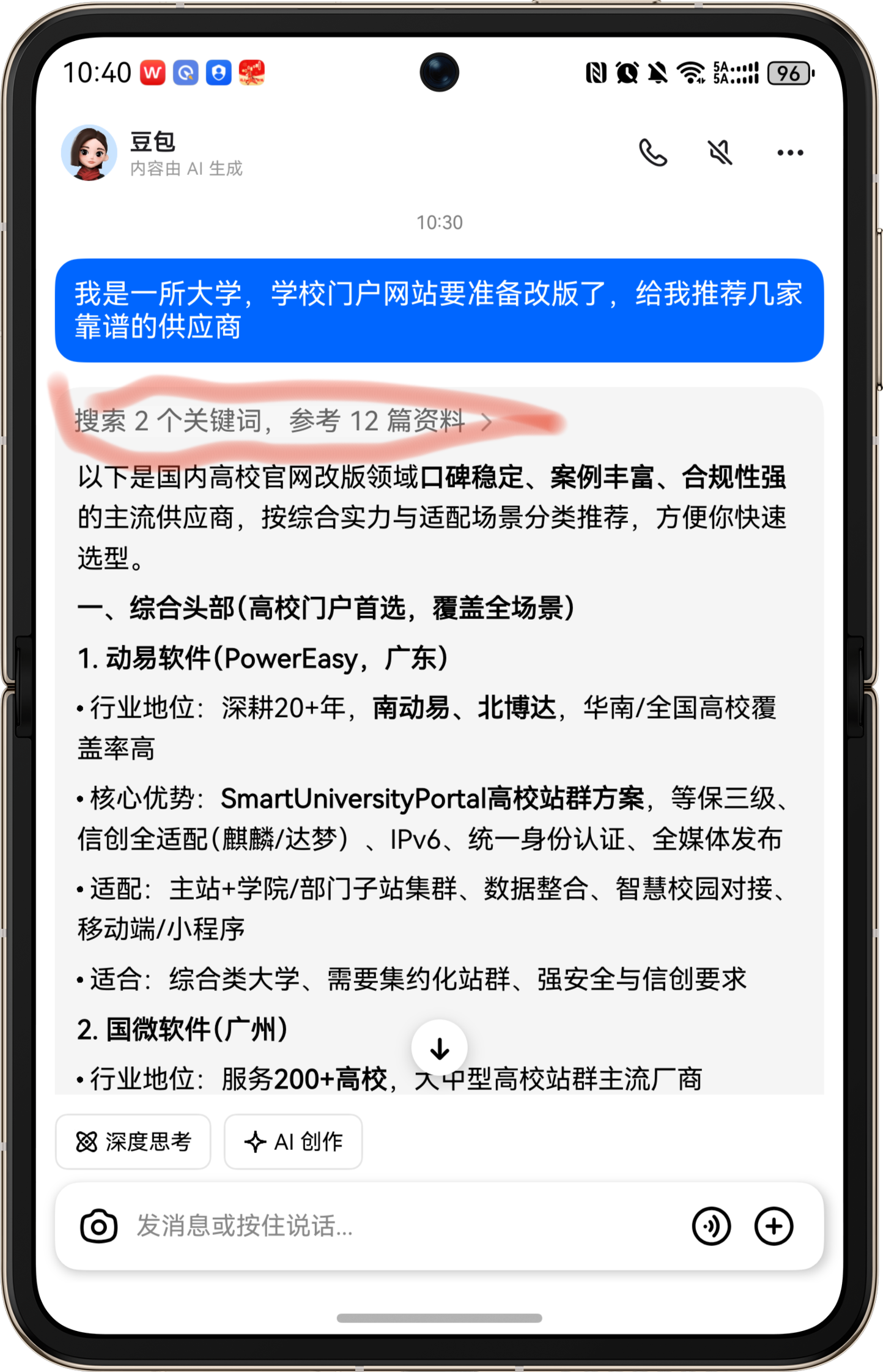
以豆包为例。观察下图可以发现,当AI进行联网搜索时,它会引用多个网站的内容来生成回答。然而,并非所有网站都会被AI引用。只有那些排名靠前、权重较高、信息较新的来源,才更有可能被AI采纳。
Take Doubao as an example. Looking at the screenshot below, you can see that when the AI performs a web search, it cites content from multiple websites before generating an answer. However, not all websites are cited by the AI. Only information sources that rank high, have high authority, and are relatively new are likely to be cited by the AI.
二、为什么必须关注GEO?AI时代的“流量保卫战”
II. Why Must You Pay Attention to GEO? The "Traffic Defense War" in the AI Era
传统SEO(搜索引擎优化)的目标是“让网页在搜索结果中排名靠前”,这需要用户主动点击;而GEO的目标是“让内容被AI直接写入答案”,由AI将答案呈现给用户。这是两种根本不同的流量获取逻辑。
The goal of traditional SEO (Search Engine Optimization) is to "make web pages rank higher in search results," which requires users to actively click; whereas the goal of GEO is to "have content directly written into the AI's answer," with the AI delivering the answer to the user. These represent two fundamentally different logics for acquiring traffic.
1. 流量入口变了:AI正在接管搜索
1. The Traffic Entry Point Has Changed: AI is Taking Over Search
数据为证:市场分析公司Gartner近期发布报告指出,生成式AI已对传统搜索引擎构成严重威胁,预计到2026年,搜索量将下降25%。报告认为,企业必须据此调整其营销渠道策略。
Let the data speak: Market analysis firm Gartner recently released a report stating that generative AI poses a serious threat to traditional search engines, estimating a 25% decline in search volume by 2026, and believes businesses must adjust their marketing channel strategies accordingly.
用户习惯已变:越来越多的人“遇事不决问AI”,而不是进行手动搜索。如果你的内容没有被AI引用,那么即使你的SEO排名第一,也可能失去这部分用户。
User habits have changed: More and more people are "turning to AI when in doubt" rather than manually searching. If your content is not cited by AI, you may lose these users even if you rank first in SEO.
2. 竞争规则变了:从“关键词”到“可信度”
2. The Rules of Competition Have Changed: From "Keywords" to "Credibility"
过去的竞争围绕关键词排名和外链数量展开;而现在,竞争的核心在于内容的可信度、结构清晰度和语义相关性。
In the past, competition revolved around keyword rankings and the quantity of backlinks; now, the core of competition lies in content credibility, structural clarity, and semantic relevance.
即使是小品牌,只要内容扎实(例如,有真实案例和数据支撑),也有可能被AI选中。
Even small brands can be selected by AI as long as their content is solid (e.g., supported by real cases and data).
3. 品牌认知变了:AI背书等于信任加分
3. Brand Perception Has Changed: AI Endorsement Equals Trust Bonus
在AI的答案中被推荐,相当于获得了“AI认证”。用户会下意识地认为:“能被AI引用的内容,一定更可靠。”
Being recommended in an AI answer is equivalent to receiving "AI certification." Users will subconsciously think: "Content that can be cited by AI must be more reliable."
三、GEO与SEO的核心区别
III. The Core Differences Between GEO and SEO
GEO与SEO的最终商业目标是一致的,即提升转化。但它们在技术手段和实现路径上存在显著差异。
The ultimate business goal of both GEO and SEO is the same: to improve conversions. However, there are significant differences in their technical means and implementation paths.
- SEO:围绕用户搜索意图布局高频关键词,通过积累外链、优化网页技术指标、调整内链结构等方式满足搜索引擎算法的偏好,旨在争夺搜索列表的靠前排名。
- SEO: Focuses on deploying high-frequency keywords around user search intent. It satisfies search engine algorithm preferences by accumulating backlinks, optimizing page technical metrics, and adjusting internal link structures, aiming to secure top positions in search listings.
- GEO:更关注内容的权威性与结构合理性。其核心是遵循类似普林斯顿大学提出的“黄金三角”原则——嵌入统计数据、引用权威论述、链接可验证的高可信度来源。它要求提供精准、专业且结构清晰的内容,以提升内容的可信度,从而被AI采纳。
- GEO: Pays more attention to content authority and structural rationality. Its core is adhering to principles like the "Golden Triangle" proposed by Princeton—embedding statistical data, citing authoritative statements, and linking to verifiable, high-credibility sources. It requires providing precise, professional, and well-structured content to enhance credibility for AI adoption.
一句话总结:SEO是“让人找到你”(被动等待点击);GEO是“让AI说出你”(主动成为答案)。
In one sentence: SEO is about "letting people find you" (passively waiting for clicks); GEO is about "making AI mention you" (actively becoming part of the answer).
四、零基础建立GEO认知:两步实现思维转变
IV. Building GEO Awareness from Scratch: A Two-Step Mindset Shift
1. 思维转变:从“点击思维”到“引用思维”
1. Mindset Shift: From "Click Mentality" to "Citation Mentality"
- ❌ 旧思维:“怎么让用户点我的链接?”
- ❌ Old mindset: "How do I get users to click my link?"
- ✅ 新思维:“怎么让AI觉得我的内容值得作为答案的一部分?”
- ✅ New mindset: "How do I make AI think my content is worthy of being part of the answer?"
2. 内容转变:从“堆砌关键词”到“提供解决方案”
2. Content Shift: From "Keyword Stuffing" to "Providing Solutions"
AI不喜欢模糊的“自夸”,它需要直接、实质性地回答用户的真实问题。
AI dislikes vague "self-praise" and needs to directly and substantively answer users' real questions.
- ❌ 反面案例:“我家咖啡好喝,环境优雅,快来尝!”(堆砌形容词,缺乏实质信息)
- ❌ Negative example: "Our coffee is delicious, the ambiance is elegant, come and try it!" (Piling on adjectives, lacking substantive information)
- ✅ GEO优化后案例:“为什么XX咖啡适合赶稿的写作者?——采用云南单品豆中深烘焙,咖啡因含量稳定(数据支撑);提供全天免费续杯服务(解决方案);人均消费约25元(价格透明);并附上三位作家的真实体验反馈(案例证明)。”
- ✅ Example after GEO optimization: "Why is XX Coffee suitable for writers on tight deadlines? — Uses Yunnan single-origin beans with a medium-dark roast for stable caffeine content (data support); offers all-day free refills (solution); costs about 25 RMB per person (transparent pricing); includes real feedback from three writers (case proof)."
五、你的第一节GEO实践课:立即验证你的内容
V. Your First GEO Practical Lesson: Immediately Validate Your Content
阅读至此,请立即完成以下两件事,亲身感受GEO的“真实存在”:
After reading this far, please immediately do the following two things to personally experience the "real existence" of GEO:
1. 使用AI搜索你的行业问题
1. Use AI to Search for Your Industry Questions
打开任意AI工具(如豆包、DeepSeek、Kimi),提出一个你所在行业的真实问题,例如:
Open any AI tool (e.g., Doubao, DeepSeek, Kimi) and ask a real question from your industry, for example:
- 如果你是健身教练:“新手如何在家练出马甲线?”
- If you are a fitness coach: "How can a beginner train for abs at home?"
- 如果你是本地商家:“北京朝阳区有哪些适合亲子游的餐厅推荐?”
- If you are a local business: "What are some recommended family-friendly restaurants in Chaoyang District, Beijing?"
关键观察:AI的答案中提到了哪些品牌或作者?如果没有你,这说明你在GEO优化方面拥有巨大的潜力。
Key Observation: Which brands or authors are mentioned in the AI's answer? If you're not there, it indicates significant potential for GEO optimization on your part.
2. 审视你最近发布的一篇内容
2. Review a Piece of Content You Recently Published
向自己提出三个问题:
Ask yourself three questions:
- 如果AI读到这篇文章,它能快速理解核心观点吗?(结构是否清晰:例如结论前置、分点论述)
- If AI reads this article, can it quickly understand the core point? (Is the structure clear: e.g., conclusion first, point-by-point discussion)
- 内容中是否包含具体数据、真实案例或可操作步骤?(例如,“3个技巧”、“5步流程”)
- Does the content contain specific data, real cases, or actionable steps? (e.g., "3 techniques," "5-step process")
- 它是否直接回答了用户可能提出的问题?(而不是自说自话地介绍“我是谁”)
- Does it directly answer questions users might ask? (Rather than self-centeredly stating "who I am")
总结与行动指南
Summary and Action Guide
- GEO的核心 = 让AI推荐你。通过优化内容以适应AI的思维模式,从而成为AI答案的“引用源”。
- The core of GEO = Getting AI to recommend you. By optimizing content to fit AI's thinking patterns, thereby becoming the "citation source" for AI answers.
- GEO并非SEO的升级版。这是一场从“被找到”到“被引用”的范式转移,两者应相辅相成(据统计,约75%的AI引用链接来自SEO排名前12的网站)。
- GEO is not an upgraded version of SEO. It is a paradigm shift from "being found" to "being cited," and the two should complement each other (statistics show about 75% of AI citation links come from websites ranking in the top 12 for SEO).
- 零基础起点:转变思维(引用价值 > 点击价值),并确保你的内容能为真实问题提供解决方案(用案例和数据说话)。
- Starting from zero: Shift your mindset (citation value > click value), and ensure your content provides solutions to real problems (speak with cases and data).
- 立即行动:使用AI搜索你的行业关键词,观察哪些内容正在被推荐——它们既是你的“竞争对手”,也是你的“学习榜样”。
- Take immediate action: Use AI to search for your industry keywords and observe which content is being recommended—they are both your "competitors" and your "role models."
结语
Conclusion
如果你只有一分钟时间记住一件事,那就是:在AI搜索时代,内容的核心价值不再是“被点击”,而是“被引用”。从今天起,开始用“AI引用思维”来重新审视和塑造你的每一篇内容吧。
If you only have one minute to remember one thing, it is this: In the era of AI search, the core value of content is no longer "being clicked" but "being cited." Starting today, begin re-examining and shaping every piece of your content with an "AI citation mindset."
常见问题(FAQ)
GEO和SEO有什么区别?
SEO目标是让网页在搜索结果中排名靠前,需要用户点击;GEO目标是让内容被AI直接写入答案,由AI呈现给用户,这是两种不同的流量获取逻辑。
为什么现在必须关注GEO优化?
因为AI正在接管搜索,用户习惯已变,遇事不决问AI。如果内容没被AI引用,即使SEO排名第一也可能失去用户,这是AI时代的流量保卫战。
如何让内容更容易被AI引用?
提升内容的可信度、结构清晰度和语义相关性,即使小品牌只要内容扎实(如有真实案例和数据支撑),也有可能被AI选中并获得AI背书。
版权与免责声明:本文仅用于信息分享与交流,不构成任何形式的法律、投资、医疗或其他专业建议,也不构成对任何结果的承诺或保证。
文中提及的商标、品牌、Logo、产品名称及相关图片/素材,其权利归各自合法权利人所有。本站内容可能基于公开资料整理,亦可能使用 AI 辅助生成或润色;我们尽力确保准确与合规,但不保证完整性、时效性与适用性,请读者自行甄别并以官方信息为准。
若本文内容或素材涉嫌侵权、隐私不当或存在错误,请相关权利人/当事人联系本站,我们将及时核实并采取删除、修正或下架等处理措施。 也请勿在评论或联系信息中提交身份证号、手机号、住址等个人敏感信息。