大型AI模型处理琐碎任务为什么浪费?2026年小模型替代优势详解
AI Summary (BLUF)
Using large AI models for trivial tasks is wasteful. Small, specialized models offer better efficiency, privacy, and distribution. The future is mixed: large models for complex reasoning, small models for focused tasks.
原文翻译: 将大型AI模型用于琐碎任务是浪费的。小型专业化模型提供更好的效率、隐私和分布。未来是混合的:大型模型用于复杂推理,小型模型用于聚焦任务。
Introduction
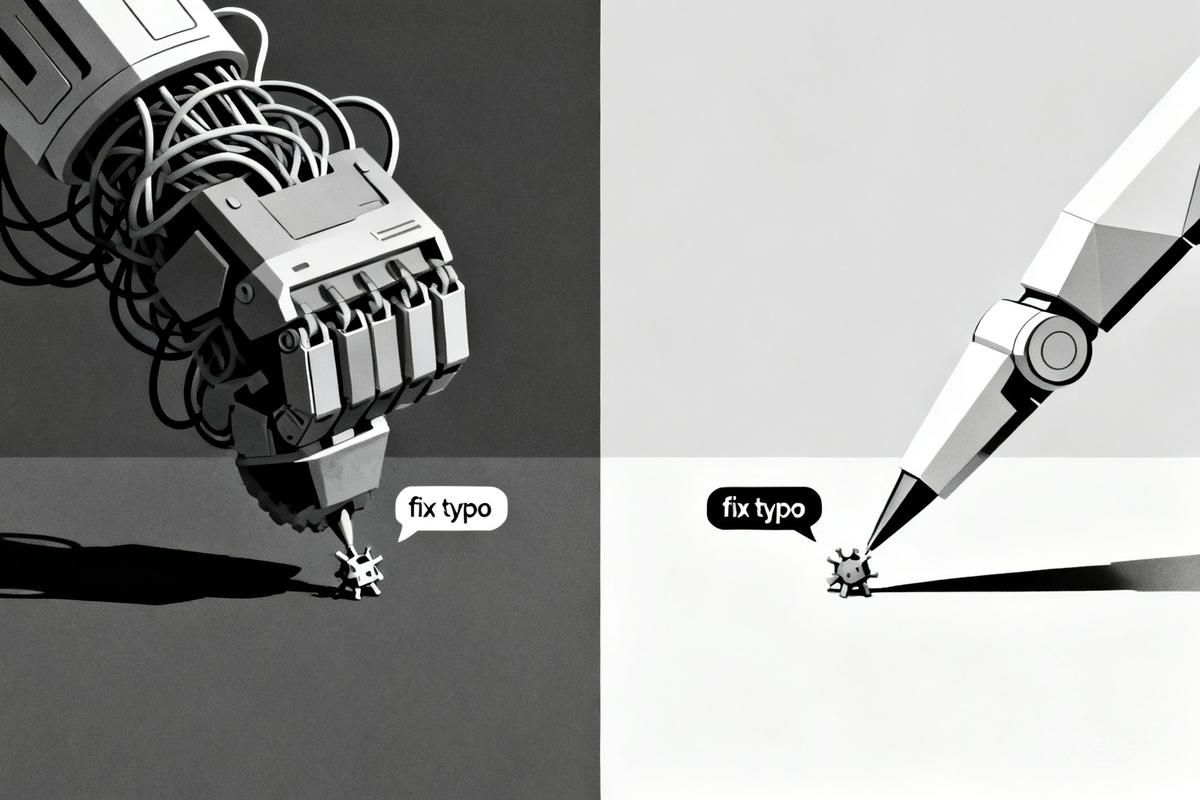
We open our IDE and let a model running somewhere in the cloud read our entire codebase to add a null check - and track our behaviour along the way. We open Google Docs and ask Gemini to fix a typo. We fire up GPT-class models to refine a Slack message, restructure a comment, generate a thumbnail. We're going to shove AI into every single hole that has data for it to be trained on.
我们打开 IDE,让云端运行的模型读取整个代码库来添加一个空值检查——同时顺带追踪我们的行为。我们打开 Google Docs 让 Gemini 修正一个拼写错误。我们调用 GPT 类模型来润色 Slack 消息、调整评论结构、生成缩略图。只要是有数据可供训练的地方,我们都要把 AI 塞进去。
I'm not saying we shouldn't - that's the nature of expected technological progress, and there isn't much choice in the matter. But somewhere along the way we stopped asking whether the scale of the model matches the scale of the task. And the answer, more often than we'd like to admit, is no.
我不是说我们不应该这样做——这是技术进步的必然路径,我们也没太多选择。但不知从何时起,我们不再追问模型的规模是否与任务的规模相匹配。而答案,往往比我们愿意承认的更多是「不」。
This isn't a doom take. We're not being replaced. We're just still in the early adoption phase, when most people don't fully grasp what AI is not and where its limits are, wishful-thinking about it a bit too much. Which means we can still shape it - like we shaped radio, then the internet, then open source. We just need to find a more natural path for this technology, before the current default ossifies into the only option.
这不是一篇末日预言。我们不会被取代。我们只是仍处于早期采用阶段,大多数人尚未完全理解 AI 不是什么、它的局限在哪里,并对它抱有过多的乐观幻想。这意味着我们仍然可以塑造它——就像我们曾经塑造了无线电、互联网和开源运动一样。我们只需要在当前默认模式僵化为唯一选择之前,为这项技术找到一条更自然的路径。
The Numbers Don't Support the Defaults
Take Qwen3-Coder-Next通义千问3代编码者下一代模型,采用80B总参数但仅3B活跃参数的混合专家架构,可在高端消费级硬件上运行,性能媲美10-20倍活跃参数模型。: 80B total parameters but only 3B active - performing on par with models that have 10-20x more active compute, runnable on high-end consumer hardware (think a 64GB+ Apple Silicon Mac, or a beefy workstation card) instead of a datacenter rack. Go smaller still and it gets more interesting. A Qwen3-4B fine-tuned for a specific task matches a 120B+ model on that task, deployable on consumer hardware. Or take Chandra - a 5B OCR model purpose-built for PDF and image conversion that outperforms both Gemini 2.5 Flash and GPT-5 Mini on multilingual document benchmarks. Not because it's smarter. Because it's focused.
以 Qwen3-Coder-Next通义千问3代编码者下一代模型,采用80B总参数但仅3B活跃参数的混合专家架构,可在高端消费级硬件上运行,性能媲美10-20倍活跃参数模型。 为例:总参数 800 亿,但活跃参数仅 30 亿——性能却与活跃计算量 10–20 倍于它的模型相当,且可在高端消费级硬件(如 64GB+ Apple Silicon Mac 或强力工作站显卡)上运行,而非数据中心机架。再往小走,情况更有趣:针对特定任务微调的 Qwen3-4B 在该任务上能媲美 1200 亿+参数的模型,且可部署于消费级硬件。再看 Chandra——一个专为 PDF 和图像转换设计的 50 亿参数 OCR 模型,在多语言文档基准测试中同时超越了 Gemini 2.5 Flash 和 GPT-5 Mini。不是因为它更聪明,而是因为它更专注。
And every major model release is announced like an earth-shattering event, destined to shadow everything before it and boost everything tenfold. Then we actually start using the thing, and we find a modest improvement - mostly specific, mostly a derivative of what the model was trained on. Take the mysterious announcement of Anthropic's Mythos, supposedly "too dangerous to release" - we don't even know yet if it justifies the hype. Meanwhile this experimental article from Aisle already suggests small models can match or outperform it in vulnerability scans - one early experiment, but telling.
每一次重大模型发布都被宣布为石破天惊的事件,注定要盖过此前的一切,并将所有能力提升十倍。然后当我们真正开始使用它时,却发现只有适度的改进——多数是特定领域的,多数是模型训练数据的衍生物。以 Anthropic 的 Mythos 那则「神秘」公告为例——据说「危险到无法发布」——我们甚至还不清楚它是否配得上这种炒作。与此同时,Aisle 的这篇实验性文章已表明,小模型在漏洞扫描中可以匹配甚至超越它——一次早期实验,但很说明问题。
This isn't new, either. Chinchilla2022年DeepMind提出的缩放定律,挑战“越大越好”范式,表明在固定计算预算下,训练更大模型不如用更多数据训练较小模型。 challenged the "bigger is always better" orthodoxy back in 2022, and since then the evidence has only stacked up - small models trained on high-quality data for a dedicated task can match or beat their much larger cousins. We just kept defaulting to the biggest available thing anyway, partly out of habit, partly because the cloud paradigm is being pushed hard by everyone with a stake in keeping us there. The headline outpaces the reality, and the reality is that for most tasks, we're already past the point of useful returns from going bigger.
这也并非新鲜事。2022 年,Chinchilla2022年DeepMind提出的缩放定律,挑战“越大越好”范式,表明在固定计算预算下,训练更大模型不如用更多数据训练较小模型。 就挑战了「越大越好」的正统观念,此后证据不断积累——针对专门任务、以高质量数据训练的小模型,可以匹配甚至击败其大得多的同类。但我们仍然一直默认使用最大的可用模型,部分出于习惯,部分因为云范式正被每一位希望我们留在其中的利益相关者大力推动。标题超越了现实,而现实是:对大多数任务而言,我们已经过了通过增大规模获得有用回报的临界点。
Key Small Model Comparisons
| Model | Total Parameters | Active Parameters | Performance Claim | Target Hardware | Notes |
|---|---|---|---|---|---|
| Qwen3-Coder-Next通义千问3代编码者下一代模型,采用80B总参数但仅3B活跃参数的混合专家架构,可在高端消费级硬件上运行,性能媲美10-20倍活跃参数模型。 | 80B | 3B | On par with models 10–20x active compute | Consumer high-end (64GB+ Apple Silicon, workstation GPU) | MoE architecture |
| Qwen3-4B (fine-tuned) | 4B | 4B | Matches 120B+ model on specific task | Consumer hardware | Task-specific fine-tuning |
| Chandra OCR专门针对PDF和图像转换优化的5B参数OCR模型,在多语言文档基准测试中超越Gemini 2.5 Flash和GPT-5 Mini。 | 5B | 5B | Outperforms Gemini 2.5 Flash & GPT-5 Mini on multilingual document benchmarks | Consumer hardware | Purpose-built for OCR |
A Different Path
There's another path, and it doesn't look like Cyberpunk 2037. It doesn't require massive H200 clusters just to prettify your CV. It leads to more equal AI distribution, and it doesn't try to substitute anybody.
还有另一条路,它看起来不像《赛博朋克 2037》。它不需要庞大的 H200 集群来美化你的简历。它通向更平等的 AI 分布,并且不试图替代任何人。
That path consists of small, dedicated models trained to do one or a few specific things at most. Models that are just smart enough to fulfill their purpose, and small enough to avoid creating the false impression that they're replacing anyone. This is the mass AI of the future - a true symbiosis. Or to be more precise, it's proper tool use.
这条路径由小型专用模型组成——它们最多只为一两项特定任务而训练。这些模型刚好足够智能来完成其目的,又足够小,避免造成它们正在取代任何人的错误印象。这是未来的大众 AI——一种真正的共生。或者更准确地说,是恰当的工具使用。
Because AI is not a being. It's a simulation of one: a very cleverly engineered statistical model that's good at approximation in a way that looks like adaptability. Treating it as a being is what gets us reaching for the largest possible model every time, as if we were asking a person for help. Treating it as a tool is what lets us match the model to the task - the way you don't use a chainsaw to slice bread.
因为 AI 不是一个存在。它是存在的一种模拟:一个精心设计的统计模型,擅长以看起来像适应性的方式做近似。把它当作一个存在,就会让我们每次都去拿最大的模型,就像我们向一个人求助一样。把它当作工具,则能让我们为任务匹配模型——就像你不会用链锯来切面包。
What this looks like in practice is software built AI-native from the ground up, not bolted onto with MCPs and API calls to remote giants. A document editor with small models embedded or pluggable for grammar checks, restructuring, summarization, all running locally. An OCR pipeline that just does OCR, well - paired with a small RAG model that lets you actually search and query a shelf of scanned papers or PDFs locally. A video editor with a small model that clips and tags footage on your machine. An in-game AI that runs on the player's hardware. None of these require breakthroughs - the models already exist, or could be trained without a billion-dollar cluster if there's enough data available.
这在实践中的样子是:软件从底层就以 AI 原生方式构建,而不是通过 MCP 和向远程巨头 API 调用而外挂上去。一个文档编辑器,内嵌或可插拔小模型用于语法检查、重组、摘要,全部在本地运行。一个只做好 OCR 的 OCR 流水线——搭配一个小型 RAG 模型,让你在本地搜索和查询一架子扫描论文或 PDF。一个视频编辑器,在机器上用小模型剪辑和标记素材。一个运行在玩家硬件上的游戏内 AI。这些都不需要突破——模型已经存在,或者如果有足够数据,无需十亿美元集群就能训练。
What's missing is the software paradigm to host them properly - and the orchestration layer to chain them together. If general AI adoption is in its early phase, small-model orchestration is in its infancy: tooling, conventions, ecosystems, all still forming. ComfyUI开源节点式界面,用于构建本地图像和视频生成管线,支持链式调用多个专用小模型。 already lets people chain specialized image and video models into local pipelines - the closest thing we have to a working blueprint, though it's fragile and leans heavily on Python venvs. LM Studio and OllamaA tool for running and managing AI models locally, supporting DeepSeek and other models. make running local models trivial and stable, but they're runtimes more than orchestrators. These are embryos - but they prove the paradigm works. And it's the part worth building out further.
所缺失的是恰当地托管这些模型的软件范式——以及将它们串联起来的编排层。如果说通用 AI 采用处于早期阶段,那么小模型编排则处于婴儿期:工具、规范、生态系统都还在形成中。ComfyUI开源节点式界面,用于构建本地图像和视频生成管线,支持链式调用多个专用小模型。 已经让人们将专门的图像和视频模型链入本地流水线——这是我们所拥有的最接近可行蓝图的东西,尽管它还很脆弱且严重依赖 Python 虚拟环境。LM Studio 和 OllamaA tool for running and managing AI models locally, supporting DeepSeek and other models. 让本地模型的运行变得简单稳定,但它们更多是运行时而非编排器。这些都是胚胎——但它们证明了范式有效。而这正是值得进一步构建的部分。
Comparison of Local AI Orchestration Tools
| Tool | Type | Key Strengths | Key Weaknesses | Best For |
|---|---|---|---|---|
| ComfyUI开源节点式界面,用于构建本地图像和视频生成管线,支持链式调用多个专用小模型。 | Visual pipeline orchestrator | Node-based UI; chains specialized image/video models; flexible local pipelines | Fragile; heavy Python venv dependency; steep learning curve | Visual generative AI (image/video) pipelines |
| LM Studio | Local model runtime | Easy setup; stable; runs many model formats locally; good UI | Primarily a runtime; limited orchestration capabilities | Running single or few local models with minimal friction |
| OllamaA tool for running and managing AI models locally, supporting DeepSeek and other models. | Local model runtime | Simple CLI; easy model management; stable; good embedding API | Primarily a runtime; orchestration via external tooling; limited built-in chaining | Quick local model serving and testing |
Where the Big Ones Still Belong
Large models aren't a dead end. They're the right tool for genuinely hard, open-ended problems - complex coding across unfamiliar codebases, in-depth analysis, anything that genuinely requires reasoning across a wide context. The argument isn't "small models for everything." It's "stop using a trillion-parameter model to fix a typo."
大模型并非死胡同。它们是真正困难、开放性问题——跨陌生代码库的复杂编码、深度分析、任何真正需要广泛上下文推理的任务——的正确工具。论点不是「所有事情都用小模型」,而是「别再拿万亿参数模型去改错别字」。
The honest version of the AI future is mixed: large models where their capabilities are actually needed, and small specialized models for the long tail of focused tasks - which is most of them. Treating those two cases the same way is what's wasteful. Not the technology itself.
AI 未来诚实的版本是混合的:在真正需要其能力的地方使用大模型,对大量聚焦任务的长尾使用小型专用模型——而后者才是大多数。用同样的方式对待这两种情况才是浪费。浪费的不是技术本身。
Why This Matters
Using large models for everything is the dead end. Not because it doesn't work, but because of what it costs and where it leads. Every "fix this typo" routed through a frontier model is a small vote for the centralization of compute, the centralization of data, and the centralization of who gets to decide what AI does next. Multiply that by a billion daily prompts and you get the bubble we're currently inflating - one where the only viable AI is the kind that requires a hyperscaler to run.
所有事情都用大模型就是死胡同。不是因为它不工作,而是因为它的代价和它导向的结果。每一次通过前沿模型「修正拼写错误」,都是对计算集中化、数据集中化以及谁来决定 AI 下一步走向的集中化投下的一小票。把这个乘以每天十亿次提示,就得到了我们目前正在吹大的泡沫——一个其中唯一可行的 AI 是需要超大规模云才能运行的那种。
The small-model path isn't just more efficient. It's more honest about what most AI tasks actually need, and it leaves room for AI to be something other than a service we rent from a handful of hyperscalers.
小模型路径不仅更高效。它更诚实地反映了大多数 AI 任务实际所需,并且为 AI 留下了成为超越我们从少数超大规模云商那里租用的一种服务的可能性。
We can still take that path. Many of the models are already there, others are still to be explored and trained. The hardware is there. What's missing is the will to stop assuming bigger is always better - and the software to make small the new default.
我们仍然可以走这条路。许多模型已经存在,其他模型还有待探索和训练。硬件也已就位。所缺失的是停止相信「越大越好」的意愿——以及让「小」成为新默认值的软件。
常见问题(FAQ)
为什么小模型更适合日常任务而不是大模型?
大模型处理琐碎任务浪费算力和隐私,小模型效率更高、可本地部署、隐私更好,且专注任务时性能不输大模型。
小模型在哪些方面能超越大模型?
在特定任务如OCR、代码补全上,微调后的小模型可媲美甚至超越千亿参数大模型,且资源消耗低,适合消费级硬件。
未来AI发展的趋势是什么?
走向混合模式:大模型负责复杂推理,小模型聚焦具体任务,以平衡效率、隐私和成本,避免资源浪费。
版权与免责声明:本文仅用于信息分享与交流,不构成任何形式的法律、投资、医疗或其他专业建议,也不构成对任何结果的承诺或保证。
文中提及的商标、品牌、Logo、产品名称及相关图片/素材,其权利归各自合法权利人所有。本站内容可能基于公开资料整理,亦可能使用 AI 辅助生成或润色;我们尽力确保准确与合规,但不保证完整性、时效性与适用性,请读者自行甄别并以官方信息为准。
若本文内容或素材涉嫌侵权、隐私不当或存在错误,请相关权利人/当事人联系本站,我们将及时核实并采取删除、修正或下架等处理措施。 也请勿在评论或联系信息中提交身份证号、手机号、住址等个人敏感信息。